
WA in Text can be confusing because two letters can carry different meanings in different conversations. For Gen Z social media users, it may appear in quick replies, DMs, comments, group chats, or casual messages where speed matters more than formal grammar today. 🌐
In many chats, WA can work as a short form of “what,” especially when someone is surprised, confused, or asking for clarification.
It can also refer to WhatsApp or other meanings when the context points that way. This guide explains how to read the term naturally, when to use it, and when a clearer word is usually better. 💬
Wa Mean in Text Quick Meaning
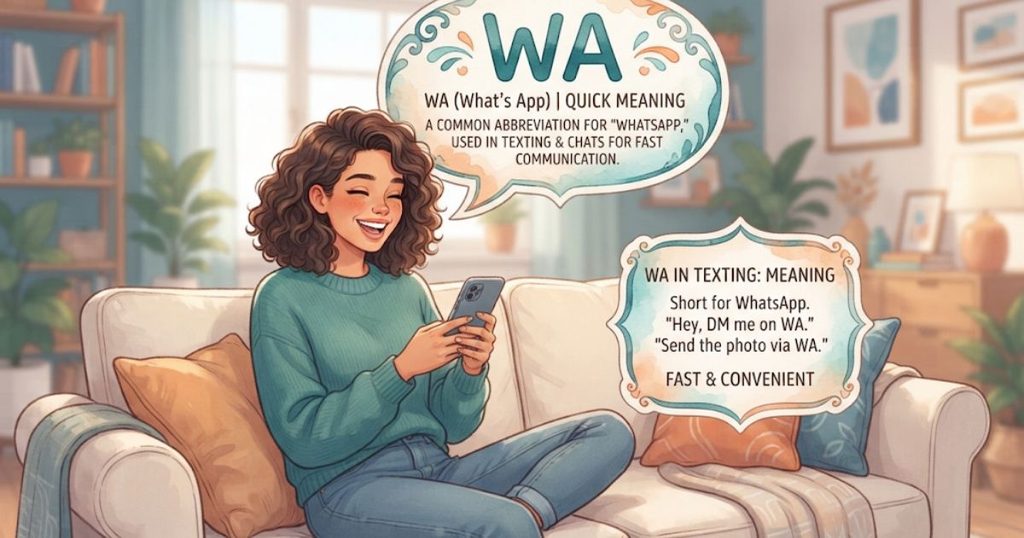
WA in Text does not have one universal definition. In casual digital communication, the meaning depends on the sentence, punctuation, platform, and relationship between the people chatting.
The most common casual uses include:
• ✨ “What” as a shortened texting form, especially in phrases such as “wa you doing?”
• 🔎 A reaction showing confusion, surprise, disbelief, or curiosity.
• 📱 “WhatsApp” when someone is discussing the messaging platform.
• 🗺️ A location abbreviation, such as Washington or Western Australia, when the subject is geography.
• ⌨️ A quick typo or shortened spelling caused by fast mobile typing.
The safest approach when reading WA in Text is to read the whole message instead of translating WA by itself. If someone writes “Send it on WA,” the app meaning is much more likely. If they write “WA? You did that?” the expression is more likely a reaction.
Examples in short messages:
• 💭 “Wa you doing?” means “What are you doing?” in casual shorthand.
• 😮 “WA?? You actually won?” expresses surprise or disbelief.
• 📲 “Send the photo on WA” usually means WhatsApp.
• ❓ “WA happened?” is an informal version of “What happened?”
• 🗣️ “WA do you mean?” asks for clarification in a very casual style.
Origin & Background
WA does not have one confirmed origin as a modern texting expression. Its use developed alongside the broader habit of shortening words in digital communication. Early texting encouraged brief messages, while social platforms later made rapid, informal writing even more common.
When WA is used as a shortened version of “what,” it follows a simple phonetic and typing pattern. People sometimes remove letters from common words because the intended meaning remains understandable to friends who share the same online style.
WA can also become an abbreviation for a name or place. WhatsApp is one important example. Geographic uses such as Washington and Western Australia are separate from texting slang and should not be treated as the same meaning.
This is why a dictionary style definition is not enough. Context decides what the sender intended. The surrounding words usually provide a stronger clue than the letters themselves.
Real-Life Conversations
Conversation 1: WhatsApp Chat
Person A: “Wa you doing tonight?”
Person B: “Nothing much. I might stay home.”
Here, WA is a casual shortened form of “what.” The sentence is informal and would not normally appear in formal writing.
Another example is:
Person A: “Can you send me the document?”
Person B: “Sure, I’ll send it on WA.”
In this case, WA clearly points to WhatsApp because the conversation is about sending a document through a messaging platform.
Conversation 2: Instagram DM
Person A: “I finally got the internship!”
Person B: “WA!! Seriously? That’s amazing!”
Here, the term works as an emotional reaction. The capital letters and exclamation marks make the surprise stronger.
If the same person wrote “WA you mean?” the function would be different. The sender would be asking for clarification rather than simply reacting.
Conversation 3: TikTok Comment
User A: “I did not expect that ending.”
User B: “Wa?? I thought the same thing!”
The short reaction fits a fast social media environment. The commenter is showing surprise and agreement without writing a complete sentence.
Conversation 4: Casual Text Message
Person A: “Everyone is talking about yesterday.”
Person B: “Wa happened?”
The meaning is close to “What happened?” The spelling is deliberately informal and should be understood through the surrounding conversation.
Emotional & Psychological Meaning
The emotional meaning of WA in Text depends heavily on punctuation and context. A lowercase “wa?” can sound like mild confusion, while “WA??” may communicate stronger surprise. “WA!!!” can sound excited, shocked, or urgent.
Personal-style scenario:
Imagine a friend tells you, “I just met your favorite singer.” A quick reply such as “WA?? Where?” shows immediate surprise and curiosity. The sender is not carefully constructing a grammatical sentence. They are reacting in real time.
That emotional speed is part of modern texting culture. Short expressions can communicate a feeling before the person has time to write a complete response.
However, WA does not automatically show a specific emotion. A reader should consider the full message, previous conversation, punctuation, and relationship. Assuming an emotional meaning without context can create unnecessary confusion.
Usage in Different Contexts
Social Media
On Instagram, TikTok, Snapchat, and similar platforms, WA may appear in comments, captions, replies, and direct messages. Short forms fit the fast pace of social media, where people often react with a few words.
Friends & Relationships
Among friends, WA can feel natural because both people already understand each other’s texting habits. A message such as “WA bro?” can sound casual and friendly. With someone you barely know, the same message may feel unclear.
Work or Professional Settings
Professional communication requires more clarity. If WA means “what,” writing the full word is safer. If it means WhatsApp, writing “WhatsApp” may also be clearer when the audience is unfamiliar with the abbreviation.
Casual vs Serious Tone
WA works better in relaxed conversations than in serious discussions. During a sensitive conversation, a short “WA?” might appear dismissive even when the sender only meant “What?”
Context matters more than the abbreviation itself. Match your wording to the seriousness of the situation.
When NOT to Use It
There are several situations where standard wording is a better choice:
• 📚 School assignments should use standard English instead of casual texting shortcuts.
• 💼 Job applications and professional emails should prioritize clarity and complete words.
• 🧾 Official documents should avoid ambiguous internet shorthand.
• 🤝 Important conversations can become confusing when the other person does not know the abbreviation.
• 🌍 Cross-cultural communication benefits from simple wording because slang does not always transfer well.
If you are unsure whether the other person understands WA, use “what,” “wait,” or “WhatsApp” instead. Clarity is more useful than saving two or three characters.
Common Misunderstandings
One common mistake is assuming that WA always means “what.” It may refer to WhatsApp, a place, or another abbreviation depending on the conversation.
Another mistake is assuming that WA always expresses surprise. Sometimes it is simply a shortened question. For example, “Wa you doing?” is more about asking a question than showing shock.
Punctuation can also change the feeling:
• 🙂 “wa?” can sound like mild confusion.
• 😯 “WA?” can look more surprised.
• 😳 “WA??” can show stronger disbelief.
• 😂 “WA!!” may communicate playful excitement.
Capitalization is not a fixed rule, though. People often type casually without thinking about uppercase and lowercase letters.
A third misunderstanding happens when someone sees WA in a location. In an address such as “Seattle, WA,” it refers to Washington state, not texting slang.
WA in Text vs Similar Short Forms
| Expression | Likely meaning | Typical context | Tone |
| WA | What or reaction | Casual chat | Informal |
| What? | Full question | Most settings | Clear |
| Huh? | Confusion | Casual chat | Informal |
| Wait | Asking someone to pause | General conversation | Neutral |
| WYM | What you mean | Texting and social media | Informal |
| Messaging platform | Chat and work | Clear | |
| WA | Washington | Address or location | Formal abbreviation |
The key difference is context. A short expression can be understood correctly when the surrounding words make its purpose obvious.
Variations and Types of WA
WA?
A simple “WA?” can mean “What?” and may express confusion or a request for clarification.
WA??
Adding another question mark can make the reaction feel more surprised or doubtful. It is common in emotional chats, although punctuation does not have a fixed universal meaning.
WA!!
This form can communicate excitement, shock, or an urgent reaction. The exact emotion depends on the message before it.
Wa you doing?
This is a casual shortened version of “What are you doing?” It is more common in relaxed conversations than formal writing.
Wa happened?
This can mean “What happened?” The meaning is usually obvious when the message follows an unexpected event.
WA bro?
The word “bro” adds a friendly and informal relationship signal. It may be used when someone is confused about a friend’s action.
WA seriously?
This form usually communicates disbelief. It can be playful or genuinely surprised depending on the conversation.
How to Respond When Someone Uses It
If you understand the meaning of WA in Text, respond to the actual question or emotion rather than focusing on the abbreviation. If the meaning is unclear, a simple clarification is better than guessing.
Casual Replies
• 🌟 “What happened?”
• 😄 “Yeah, I know, crazy right?”
• 👀 “Wait until you hear the rest.”
• 🙌 “I’ll explain.”
Funny Replies
• 😂 “Relax, I’ll explain everything.”
• 🤭 “That reaction was expected.”
• 😎 “You were not ready for that.”
• 🎭 “Plot twist!”
Mature Replies
• 🧠 “Let me explain what I meant.”
• 📌 “Here is the situation.”
• 💡 “I can clarify that for you.”
• 🗣️ “I think there was a misunderstanding.”
Respectful Replies
• 🤍 “Sure, I can explain.”
• 🌿 “Sorry for the confusion.”
• 🙏 “Let me make that clearer.”
• ✨ “I understand your question.”
Regional & Cultural Usage
Western Culture
In English-speaking online communities, shortened expressions are common in casual digital communication. Younger users may understand them quickly, while formal settings usually favor standard English.
Asian Culture
WhatsApp is widely used across many Asian communities, so WA can sometimes be understood as a shortened reference to the platform. At the same time, local languages and texting habits influence how short forms are interpreted.
Middle Eastern Culture
In multilingual online conversations, abbreviations can shift meaning quickly. A sender may use WA to refer to WhatsApp, while another person may read it as a shortened reaction. The conversation itself provides the best clue.
Global Internet Usage
Internet language moves across borders quickly. A phrase created or popularized in one online community can appear elsewhere without carrying exactly the same meaning. That is why WA should not be treated as a universal slang term.
Generational Differences
Younger social media users may be comfortable with short forms because they encounter them frequently. Older users or people who do not spend much time on social platforms may prefer complete words.
Is It Safe for Kids?
WA itself is generally a harmless piece of informal texting language. The term does not automatically contain offensive or adult content.
The important lesson for younger users is context. Children and teenagers can understand that casual slang belongs in casual conversations, while schoolwork, formal emails, and communication with teachers require clearer language.
Parents and educators can explain that knowing slang is different from using it everywhere. Learning when to switch between informal and standard English helps young people communicate more effectively.
How to Read WA in Text Instantly
To understand WA in Text, start with the words around WA. If the message includes “send,” “message,” “group,” “number,” or “call,” WA may refer to WhatsApp.
If it appears before a question or reaction, it may be a shortened “what.” If it appears in an address, it may refer to Washington. If the conversation concerns Australia, Western Australia may be the intended meaning.
Next, check punctuation and tone. “WA?” is different from “Send it on WA.” Finally, consider who sent the message and what you were discussing immediately before it.
Why Short Forms Like WA Keep Appearing Online
WA in Text reflects how digital communication rewards speed, convenience, and personal style. Users often shorten familiar words because the meaning can still be understood from context.
Social media also encourages expressive writing. Capital letters, repeated punctuation, abbreviations, and intentional misspellings can make a message feel faster or more emotional.
For Gen Z users, this style is often less about perfect grammar and more about sounding natural in the moment. Still, the best short form is one that the reader can understand without extra explanation.
Frequently Asked Questions
What does wa mean in chat?
WA can mean “what” in casual texting, but it may also refer to WhatsApp or another meaning depending on the context.
Is wa a real word?
As texting slang, WA is not normally standard English. It is usually an informal shortening, abbreviation, or reaction.
Can wa mean surprise?
Yes. “WA?” or “WA??” can express surprise, disbelief, confusion, or excitement when the context supports that interpretation.
Is wa appropriate in professional messages?
Usually, complete wording is clearer in professional messages. Write “what” or “WhatsApp” when ambiguity could cause confusion.
Why do people type wa instead of what?
People may shorten words to type faster, sound casual, or match the informal style of a conversation.
Does wa have the same meaning everywhere?
No. WA can have different meanings depending on the sentence, country, platform, and subject of the conversation.
Is wa considered slang?
When WA is used as casual shorthand for “what” or as an emotional reaction, it is generally considered informal texting slang.
Conclusion
Understanding WA in Text is mainly about context rather than memorizing one fixed definition. 🔍In casual chats, it can shorten “what,” express surprise, show confusion, or refer to WhatsApp. 💬The words around it, punctuation, platform, and relationship usually reveal the intended meaning. 🌐
For school, work, and serious conversations, standard wording is usually clearer and easier to understand. ✍️When you are unsure, ask what the sender means instead of guessing. 🤝Once you learn to read the context, WA becomes a simple and easy part of modern digital communication.