
Someone texts you “icl that outfit was fire” and you pause. You know NGL. You know TBH. But this one feels new, and asking out loud seems like a bad move.
This guide breaks it down properly. By the end, you’ll know exactly what ICL means, where it started, and how to drop it into a chat without overthinking it.
What Does ICL Mean?
ICL stands for “I Can’t Lie.” It’s a short phrase people use right before sharing an honest opinion, even one that might be a little awkward or unexpected.
- I ,I
- C ,Can’t
- L ,Lie
There’s also a less common second meaning: “I Care Less.” This version signals indifference rather than honesty, so tone and context decide which one is meant.
Most of the time, though, when you see this term in a chat, it’s setting up a genuine opinion the sender wants you to trust.
What Does ICL Mean in Slang
As slang, this phrase works as a truth-signal. It tells the reader that what comes next is real, not sugar-coated.
It sits in the same family as “no cap” and “tbh,” where the whole point is flagging sincerity before making a statement. The difference is tone. Where “no cap” can sound almost like a dare, this phrase feels more personal, sometimes even a little vulnerable.
People often use it before admitting something they’re slightly embarrassed about, or before giving blunt feedback a friend actually asked for.
Slang like this also tends to travel in pairs or small clusters. Once one honesty-marker catches on, a few close variations usually follow, each carrying a slightly different shade of meaning even though the core function stays the same.
What Does ICL Mean on Snapchat
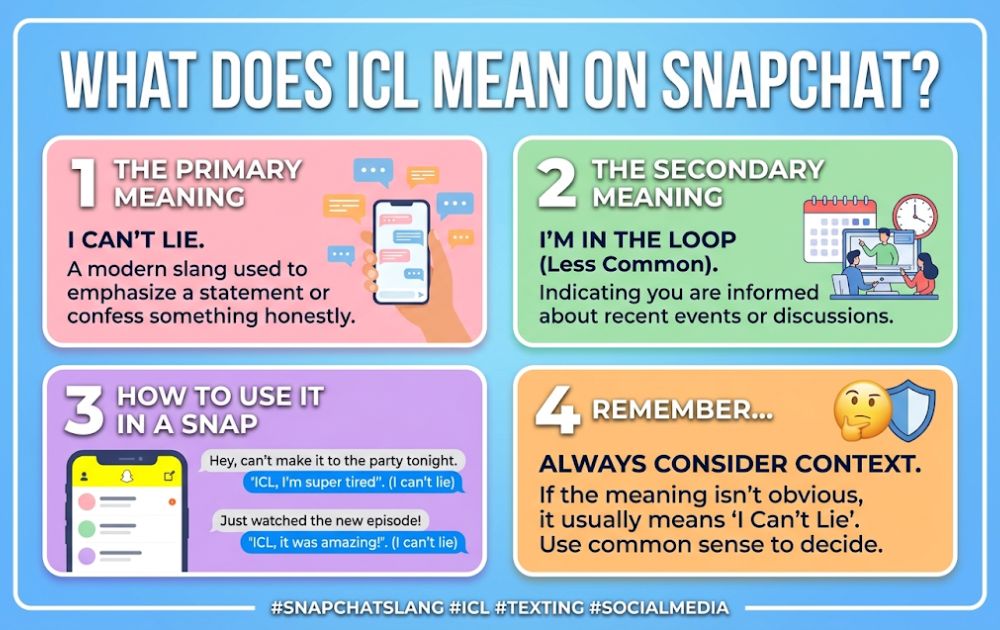
On Snapchat, this abbreviation shows up constantly in DMs and quick replies. It fits naturally into Snapchat’s fast, back-and-forth messaging style, where full sentences often get replaced by short, punchy phrases.
You’ll typically see it open a message rather than sit in the middle of one. A Snap might simply read “icl i miss you” or “icl this is the best thing i’ve eaten all week.” The brevity matches how Snapchat conversations move ,quick, casual, and low-effort by design.
Because Snapchat leans heavily on disappearing messages, users also tend to be more direct there than on platforms where posts stick around permanently. That temporary nature seems to lower the stakes of being fully honest, which may be part of why this kind of phrase feels so at home there.
What Does ICL Mean on TikTok
TikTok uses this term differently ,mostly in comments and captions rather than private messages. A comment might read “icl this video changed my mind” or a caption might open with “icl I wasn’t expecting to relate to this.”
Because TikTok content is public and often opinion-driven, the phrase does real work there. It separates a personal, honest reaction from a generic comment, which helps a comment stand out or feel more authentic to other viewers scrolling past.
Duets and stitches also use it often, especially when someone is reacting to another creator’s take and wants to signal they’re being straightforward about their opinion. In comment sections packed with sarcasm, this small flag of sincerity can genuinely change how a message is read.
What Does ICR Mean in Text
ICR is a separate, less common cousin of this phrase, standing for “I Can’t Remember.” It’s easy to confuse the two since they share two letters and a similar three-letter format, but the meanings don’t overlap at all.
Where the honesty-focused term introduces an opinion, ICR is used when someone genuinely can’t recall a detail. A text might read, “icr what time we said, can you check?” It’s functional, not emotional, and doesn’t carry the same confessional tone.
Mixing up these two abbreviations is a common beginner mistake, so it’s worth keeping the distinction clear. If the sentence that follows is an opinion or feeling, it’s almost certainly the honesty term. If it’s about a forgotten fact or detail, it’s the memory-related one instead.
Origin and History of “ICL”
This phrase grew out of the same texting culture that produced “tbh” and “ngl.” As mobile messaging matured through the 2010s, users leaned harder into abbreviations that let them add emotional context without typing full sentences.
“I can’t lie” was already a common spoken phrase in casual English before it got shortened for texting. Compressing it into three letters was a natural next step once character limits and fast-paced group chats became the norm.
Its rise online tracks closely with platforms built around short-form, high-volume communication ,Twitter threads, Snapchat streaks, and later TikTok comment sections all rewarded phrases that packed meaning into as few characters as possible.
There’s no single viral moment credited with this abbreviation. It spread gradually, the way most durable texting slang does, through repeated everyday use rather than one specific trend.
Regional texting habits also played a role. In group chats where honesty framing was already common ,friends prefacing opinions with “not gonna lie” or “to be honest” ,the shortened version simply became one more option in an already-established pattern of speech, rather than something entirely new that needed explaining.
How “ICL” Is Used on Different Platforms
Usage shifts slightly depending on where you see it.
| Platform | Typical Use | Tone |
| Snapchat | Opening line in a DM | Personal, direct |
| TikTok | Comments and captions | Reactive, opinion-driven |
| Twitter/X | Leading into a hot take | Blunt, sometimes provocative |
| Captions or comment replies | Casual, confessional |
Twitter and X tend to use it in a slightly sharper way, often right before an opinion the poster expects some pushback on. Instagram usage feels closer to Snapchat ,softer, more personal, less about starting arguments.
ICL in Texting vs. Real Life
This term was built for typing, and it mostly stays there. Saying “I-C-L” out loud sounds unnatural, so almost nobody actually speaks the abbreviation itself.
In texting, it works as a quick signal before an honest statement. It saves time and adds emotional context in three characters instead of a full sentence.
In real life, people either say the full phrase ,”I can’t lie, that was actually really good” ,or skip the phrase entirely and just state their opinion. The abbreviated version rarely survives the jump from screen to speech.
This pattern is common across most texting slang. Abbreviations exist to solve a typing problem, not a speaking one, so plenty of them never make it into spoken conversation at all.
Examples of “ICL” in Sentences
Seeing the phrase across different contexts makes the pattern easier to pick up.
Everyday/casual:
- “icl I’ve watched that show like five times.”
- “icl this coffee shop is overrated.”
Confessional/vulnerable:
- “icl I’ve been kind of stressed lately.”
- “icl I miss how things used to be.”
Feedback/opinions:
- “icl your last edit was better than this one.”
- “icl that outfit doesn’t really work for the theme.”
Reaction/comment use:
- “icl this comment section is sending me.”
Across every example, the phrase does the same job: it flags what follows as an honest, unfiltered thought rather than a polite or exaggerated one.
Variations and Related Slang
This abbreviation sits inside a bigger group of honesty-signaling texting terms, and it helps to know how they differ.
| Term | Meaning | How It Differs |
| NGL | Not Gonna Lie | Nearly identical meaning, more widely used |
| TBH | To Be Honest | Slightly more neutral, less confessional |
| Fr | For Real | Emphasizes truth without softening tone |
| ICR | I Can’t Remember | Unrelated meaning despite similar letters |
| No cap | No lie, I’m serious | More emphatic, often used to end a statement |
NGL is the closest match in meaning and is used far more often overall, but this phrase tends to show up when the statement feels a little more personal or unexpected.
Why Honesty Slang Is Taking Over Gen Z Texting
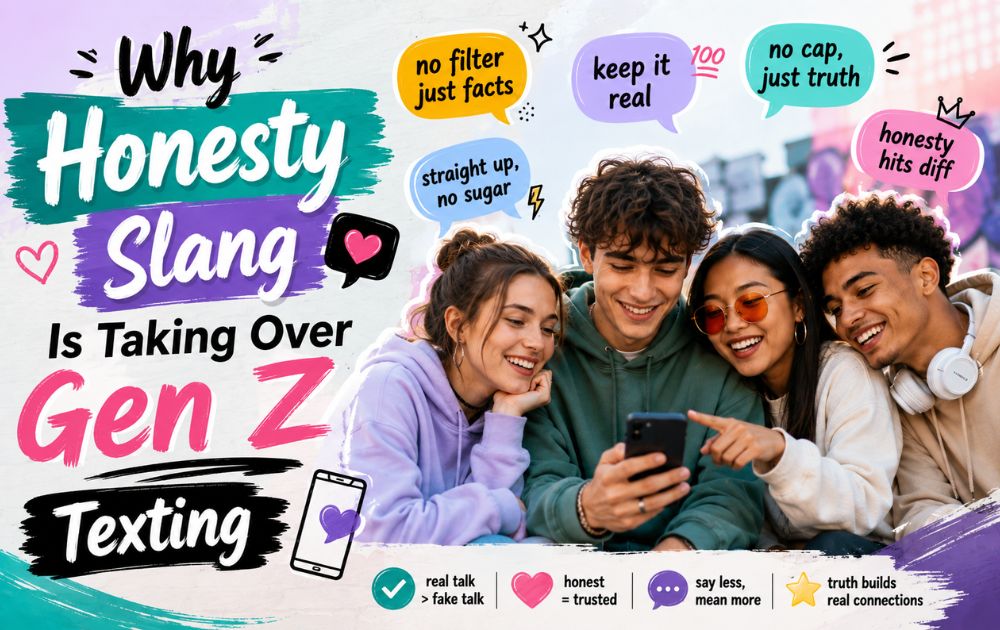
Terms like this one, along with NGL and “no cap,” reflect a broader shift in how younger users communicate online. Instead of assuming sincerity, digital conversation increasingly flags it explicitly, almost like a built-in disclaimer.
Part of this comes from growing up in spaces full of exaggeration, sarcasm, and irony-heavy humor. When almost anything can be a joke, a short phrase that says “this part is real” carries real weight.
Expect this pattern to keep expanding rather than fading, since it solves a genuine communication problem rather than existing purely as a trend. As group chats and comment sections get noisier, short honesty markers give readers a fast way to tell sincerity apart from sarcasm without needing extra explanation.
How Slang Like “ICL” Signals Trust in Digital Friendships
Short honesty markers do more than save typing time ,they function as small trust signals between friends. Using one tells the other person you’re choosing sincerity over performance, even in a low-stakes text.
Over repeated conversations, these tiny cues add up. A friend group that regularly uses phrases like this one tends to associate them with authenticity, which reinforces the term’s meaning every time it’s used correctly.
This is part of why slang like this spreads so effectively inside close friend groups before expanding to wider platforms ,it’s tied to real social behavior, not just aesthetics.
It also explains why the phrase rarely feels forced when used correctly. Unlike slang that exists mainly for style, honesty markers carry a functional purpose, which tends to make them last longer than purely aesthetic trends that fade once the novelty wears off.
Is “ICL” Safe for Kids?
Yes. This is a harmless honesty phrase with no hidden or inappropriate meaning.
- It’s used to introduce a truthful opinion or feeling.
- It carries no aggressive, offensive, or adult undertone.
- It’s common in everyday teen and tween texting.
- Parents and teachers have no real reason to flag it.
The only thing worth noting is tone. Since it often introduces blunt feedback, the phrase itself is fine, but what follows it could occasionally be harsh ,that’s a communication issue, not something caused by the abbreviation.
When to Use (and Avoid) “ICL”
Good times to use it:
- Sharing an honest opinion a friend actually asked for
- Admitting something slightly embarrassing in a casual chat
- Reacting genuinely to a video, post, or photo
- Softening blunt feedback with a personal tone
Times to skip it:
- Formal emails or professional messages
- Conversations with someone you don’t know well
- Academic writing or schoolwork
- Situations where slang could come across as dismissive
As with most texting slang, context decides whether it lands well or feels out of place.
Frequently Asked Questions
What does ICL mean in text?
ICL stands for “I Can’t Lie.” It’s used before an honest opinion or admission in casual texting.
Is ICL the same as NGL?
They’re very similar in meaning, but this phrase often feels slightly more personal, while NGL is more widely used overall.
Can ICL mean something else?
Yes, it can also mean “I Care Less,” which shows indifference rather than honesty, depending on tone.
Is ICL only used by teens?
No, though it’s most common among Gen Z, young adults use it casually across texting and social media too.
Does ICL work the same way on every platform?
Mostly, yes. It leans more personal on Snapchat and Instagram, and more opinion-driven on TikTok and Twitter/X.
Is ICL appropriate for professional messages?
No. Like most casual slang, it doesn’t belong in formal emails, meetings, or workplace writing.
What’s the difference between ICL and ICR?
ICL means “I Can’t Lie,” while ICR means “I Can’t Remember.” They look similar but have completely different meanings.
Conclusion
ICL is a short, honest way of saying “I can’t lie” before sharing a genuine opinion, feeling, or reaction. It’s common on Snapchat, TikTok, and other Gen Z-heavy platforms, almost always typed rather than spoken.
Whether you’re using it to admit something small or flag an honest opinion, this phrase is an easy piece of slang to understand once you know the pattern ,and one of the more genuine ones in everyday texting.