
If you have ever received a message saying “SMH” and wondered what the person meant, you are definitely not alone. What Does SMH Mean in Text? It usually means “shaking my head,” a short reaction used to show disbelief, disappointment, frustration, or disapproval.
It is common in casual conversations, comments, group chats, and social media posts. The exact feeling can change depending on the situation and the relationship between the people talking. Sometimes SMH sounds serious, while other times it is playful or sarcastic. Understanding the surrounding message is the easiest way to know what the sender really means.
For Gen Z social media users, abbreviations such as SMH make conversations quicker without needing a long explanation. Instead of writing “I cannot believe you did that,” someone may simply type “SMH.” The expression turns a familiar physical reaction into three simple letters.
Cambridge Dictionary defines SMH as an abbreviation for “shaking my head” and notes that it is used in texts and on social media when someone does not believe or approve of something.
Hook: Ever Seen “SMH” and Felt Confused?
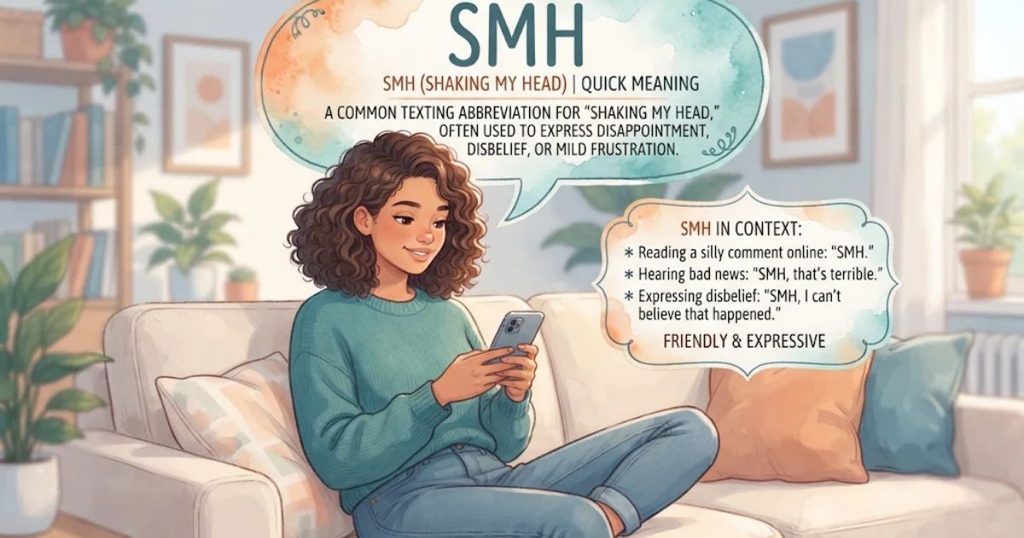
Seeing SMH for the first time can be confusing because the three letters do not immediately reveal their meaning.
Unlike ordinary words, texting abbreviations depend heavily on context. The same SMH can sound mildly amused in one conversation and genuinely disappointed in another.
The most common meaning is “shaking my head.” It represents the reaction people make when something seems silly, frustrating, unbelievable, disappointing, or simply difficult to understand.
For example:
👉 “You forgot your keys again? SMH.”
Here, the sender is not necessarily furious. They may simply be saying, “Seriously? How did you do that again?”
That is one reason SMH works so well in casual digital conversations. It communicates an attitude without requiring a long explanation.
What Does “Whats SMH Mean”?
The phrase “Whats SMH Mean” is essentially asking for the full meaning behind the abbreviation.
SMH stands for “shaking my head.” In texting and social media, it is commonly used as a reaction to something a person finds unbelievable, disappointing, frustrating, or ridiculous. Dictionary.com also defines SMH as “shaking my head” or “shake my head,” particularly when expressing disbelief, disgust.
Featured Snippet Definition:
SMH means “shaking my head.” It is an internet slang abbreviation used in texts, comments, and social media to express disbelief, disappointment, frustration, or disapproval.
The abbreviation can appear at the beginning or end of a sentence.
Examples include:
👉 “SMH, you really did that?”
👉 “I missed the bus again smh.”
👉 “That decision makes no sense, SMH.”
The basic meaning stays the same, but the emotional tone depends on the conversation.
Simple Meaning (In Easy Words)
In simple words, SMH means something like:
👉 “I cannot believe this.”
👉 “Seriously?”
👉 “What were you thinking?”
👉 “That is disappointing.”
👉 “I have no words.”
👉 “Come on, really?”
It does not always indicate strong anger. Often, it is simply a quick reaction to something that seems silly or frustrating.
Imagine your friend tells you they studied for an exam but forgot to bring a pen. You might reply, “SMH.” You are expressing disbelief, but you may also be joking with them.
The phrase can also be directed at yourself.
For example:
👉 “I left my phone at home again. SMH.”
Here, the person is laughing at their own mistake rather than criticizing someone else.
This flexible meaning is why What Does SMH Mean in Text is best understood through context rather than through one fixed emotional definition.
Where Is “SMH” Used?
SMH can appear almost anywhere people have informal digital conversations. Its meaning generally remains “shaking my head,” even when the platform changes.
Common Platforms:
| Platform or Setting | Typical Use |
| Text messages | Quick reaction to a friend’s mistake |
| Group chats | Reaction to something surprising or silly |
| Comments, captions, replies, and DMs | |
| TikTok | Reaction to videos or comments |
| Snapchat | Casual reactions between friends |
| X | Reactions to posts, opinions, or situations |
| Responses to surprising or frustrating discussions |
The expression is especially suitable for informal communication. It is less appropriate for formal emails, academic writing, professional reports, or serious official communication.
Example situations:
A friend cancels plans at the last minute:
👉 “You canceled again? SMH.”
Someone sends a message to the wrong person:
👉 “I just sent that screenshot to them. SMH.”
Someone makes an obvious mistake:
👉 “He forgot his own birthday party. SMH.”
In each situation, the abbreviation works as a compact emotional reaction.
Why Do People Use “SMH”?
People use SMH because it communicates a recognizable reaction with very little effort.
Quick & easy
Typing three letters is faster than writing an entire sentence explaining disappointment or disbelief.
This is especially useful in fast moving group chats where conversations can move quickly.
Emotion based
SMH adds emotional context to a message. Without it, a sentence may sound neutral.
Compare:
“You forgot your homework.”
“You forgot your homework? SMH.”
The second version clearly communicates a reaction.
Perfect for reactions
Sometimes people do not need to explain their feelings. A short reaction is enough.
A standalone “SMH” can communicate disbelief, mild frustration, amusement, or disappointment depending on the conversation.
Universal slang
SMH has become widely recognized in online communication. Dictionary.com notes that the abbreviation emerged in digital communication and became established as internet slang during the 2006
That widespread recognition makes it easy to use with people who are familiar with internet language.
Real Life Examples of SMH
Learning What Does SMH Mean in Text becomes easier when you see how people might naturally use it.
Example 1:
Friend: “I forgot my wallet after driving all the way to the store.”
Reply: “SMH, you are going to have to go back.”
The response shows mild frustration or amusement.
Example 2:
Friend: “I accidentally deleted the assignment before submitting it.”
Reply: “SMH. Did you save a copy?”
Here, SMH shows disbelief while the second sentence shows concern.
Example 3:
Friend: “I stayed awake all night and forgot the exam was tomorrow.”
Reply: “You had one job. SMH.”
The phrase adds a teasing tone.
Example 4:
Person: “I sent the message to the wrong group chat.”
Reply: “SMH 😭”
This version can be playful because the emoji adds emotional context.
These examples demonstrate an important point: SMH does not automatically mean hostility. The surrounding words, punctuation, emojis, and relationship between the people can change the tone.
SMH vs Similar Internet Terms
SMH is often confused with other short internet expressions because many of them communicate emotional reactions.
| Term | Common Meaning | Main Feeling |
| SMH | Shaking my head | Disbelief or disappointment |
| LOL | Laughing out loud | Amusement |
| OMG | Oh my God | Surprise or shock |
| IDK | I do not know | Uncertainty |
| FR | For real | Agreement or emphasis |
| WTF | Strong surprise or frustration | More intense reaction |
| Facepalm | Embarrassment or disbelief | Frustration |
Key Difference:
The key difference is that SMH specifically suggests the imagined action of shaking your head because something is disappointing, ridiculous, unbelievable, or frustrating.
For example, LOL normally communicates amusement, while SMH communicates a reaction closer to “I cannot believe this.”
The two can even appear together when someone finds a situation both funny and ridiculous.
When Should You Use SMH?
Knowing the meaning is only half the process. Understanding when to use it helps prevent your message from sounding rude or confusing.
Good situations:
👉 Talking casually with friends
👉 Reacting to a funny mistake
👉 Responding to something unbelievable
👉 Commenting on an obviously poor decision
👉 Joking about your own mistake
👉 Reacting to harmless social media content
👉 Showing mild disappointment in a casual conversation
SMH is most natural when the conversation is already relaxed.
Avoid using SMH when:
👉 Writing a formal professional message
👉 Speaking to someone who may not understand internet slang
👉 Discussing a sensitive personal issue
👉 Responding to serious grief or distress
👉 Communicating with someone who may interpret it as criticism
Context matters because a short abbreviation can sometimes sound harsher than intended.
The Tone Behind SMH Can Change
One overlooked part of What Does SMH Mean in Text is tone.
The abbreviation itself does not tell you exactly how strongly someone feels. The surrounding message provides that information.
Consider these examples:
“SMH 😂”
This can feel playful or humorous.
“SMH…”
The dots may make the response sound more disappointed or tired.
“SMH, seriously?”
This can sound more direct.
“I forgot my password again. SMH.”
This is usually self directed and lighthearted.
Therefore, reading only the three letters is not always enough. Look at what came before and after them.
Common Misunderstandings
Because internet slang changes quickly, SMH can sometimes be misunderstood.
It does not always mean anger
SMH can express mild disappointment, disbelief, amusement, or frustration without serious anger.
The surrounding conversation usually determines the intensity.
It is not an insult by default
Typing SMH does not automatically mean the sender is insulting another person.
A friend may use it affectionately after a harmless mistake.
It is not always serious
Many people use SMH humorously or dramatically.
For example, “I ate the whole pizza. SMH” may simply be a playful comment about their own behavior.
It is not “smile my head”
SMH is generally understood as “shaking my head.” Some people may invent humorous interpretations, but the established texting meaning is “shaking my head.”
How Capitalization Changes the Feel
SMH, smh, and Smh usually communicate the same basic meaning.
Capitalization can influence presentation rather than definition.
SMH can look stronger or more noticeable.
smh often feels casual and relaxed.
Smh is sometimes used naturally in ordinary typing.
There is no universal rule requiring one format. The choice often depends on personal texting style.
For Gen Z users, lowercase abbreviations are especially common in casual digital conversations, although capitalization varies from person to person.
SMH in Group Chats
Group chats create a different environment because several people may react at once.
A single “SMH” can function as a shared reaction when everyone already understands the situation.
For example:
Friend 1: “He forgot the tickets.”
Friend 2: “SMH.”
Friend 3: “Again?”
In this situation, SMH saves time while making the speaker’s reaction clear.
However, group chats can also increase misunderstandings because different people may read the same abbreviation differently. If the situation is sensitive, adding a short explanation can make the intended tone clearer.
How to Respond When Someone Says SMH
If someone sends SMH, your response should depend on what they are reacting to.
If they are joking, you can respond casually:
👉 “I know, I messed up.”
If they seem disappointed:
👉 “Yeah, that was my bad.”
If they are reacting to something funny:
👉 “I know right?”
If you are unsure what they mean:
👉 “Why SMH?”
A simple follow up question can prevent unnecessary misunderstanding.
You do not always need to defend yourself. Sometimes SMH is simply a playful reaction between friends.
Pro Tips for Using SMH
1. Match the tone
Read the conversation before using SMH.
If everyone is joking, it will probably sound playful. If the discussion is serious, the same abbreviation may feel dismissive.
2. Pair it with emojis
An emoji can make the intended tone easier to understand.
For example:
👉 “SMH 😂”
👉 “SMH 😭”
👉 “SMH 🤦”
The emoji gives readers another clue about whether the message is humorous, dramatic, or genuinely frustrated.
3. Do not overuse it
Using SMH in every conversation can make it lose its impact.
Save it for moments where disbelief, disappointment, or frustration is actually part of your reaction.
When SMH Can Sound Rude
Although SMH is often harmless, it can sound judgmental in certain conversations.
If someone is sharing a serious problem, replying only with “SMH” may make them feel dismissed.
Similarly, using SMH toward someone you do not know well can create the impression that you are criticizing them.
A useful rule is simple: if you would not shake your head at the person in a face to face conversation, think carefully before sending SMH.
This is especially important in public comments, where tone is harder to communicate.
Is SMH Still Used in 2026?
Yes. Current dictionary references continue to define SMH as “shaking my head,” and contemporary slang guides describe it as a common reaction used in texts and online conversations.
Its exact popularity can vary across communities and age groups, but the meaning remains recognizable.
The expression also continues to appear across social platforms and messaging environments, where short reaction based language is useful.
For someone learning modern texting slang, SMH remains a useful abbreviation to understand.
Frequently Asked Questions
What does SMH mean in text?
SMH means “shaking my head.” It is usually used to express disbelief, disappointment, frustration, or disapproval.
Is SMH rude?
SMH can sound rude depending on context, but it is often used playfully between friends.
What does SMH mean on social media?
On social media, SMH generally means “shaking my head” and signals a reaction to something surprising, disappointing, silly, or frustrating.
Can SMH be used jokingly?
Yes. People often use SMH jokingly when reacting to their own mistakes or harmless behavior.
Does SMH mean angry?
Not necessarily. SMH can show mild frustration, disbelief, disappointment, amusement, or stronger disapproval depending on context.
What is the difference between SMH and LOL?
SMH generally expresses disbelief or disappointment, while LOL is mainly used to communicate laughter or amusement.
Can I use SMH in a formal message?
It is better suited to casual texting and social media. Formal communication usually calls for clearer, standard language.
Conclusion
Understanding What Does SMH Mean in Text makes modern online conversations much easier to follow. The abbreviation normally stands for “shaking my head” and expresses disbelief, disappointment, or frustration. Its tone can range from playful teasing to genuine disapproval depending on the situation.
You can find SMH in texts, group chats, comments, captions, and other casual digital conversations. The surrounding words and emojis often reveal whether the message is serious, funny, or sarcastic. When used with the right audience and context, SMH is a simple way to express a quick reaction.