
You have probably seen “IT” everywhere :on office doors, university course lists, and app store descriptions :but the exact meaning shifts depending on where you spot it. Sometimes it is a whole industry, sometimes it is a single department, and sometimes it is not an acronym at all.
This guide breaks down what IT and related tech abbreviations actually stand for across technology, computers, university programs, and computer science, plus dozens of everyday tech terms you scroll past daily.
It covers hardware, software, networking, cloud computing, programming, business tech, and mobile terms in one place. By the end, you will be able to read a job listing, a course catalog, or a settings menu and instantly know what every abbreviation means.
Why Knowing What IT Abbreviations Stand For Matters in Tech
Tech abbreviations are not just industry jargon; they show up in job titles, phone settings, university majors, and even error messages. Misreading one can lead to picking the wrong course, misunderstanding a tech support ticket, or missing what a job posting actually requires.
- Helps you choose the right university major or career path
- Makes troubleshooting tech issues faster and less confusing
- Improves communication in workplaces that rely on shorthand
- Builds confidence when reading device settings, cloud dashboards, or code
- Reduces miscommunication between technical and non-technical team members
Understanding these terms is less about memorizing definitions and more about recognizing patterns, since most abbreviations reuse the same short list of root words like “network,” “system,” “interface,” and “service.”
Once you recognize these recurring roots, unfamiliar acronyms become far less intimidating. Instead of memorizing hundreds of separate terms, you start noticing that many abbreviations are simply different combinations of the same handful of core technology concepts, applied to different parts of a system.
What Does It Stand For in Technology?
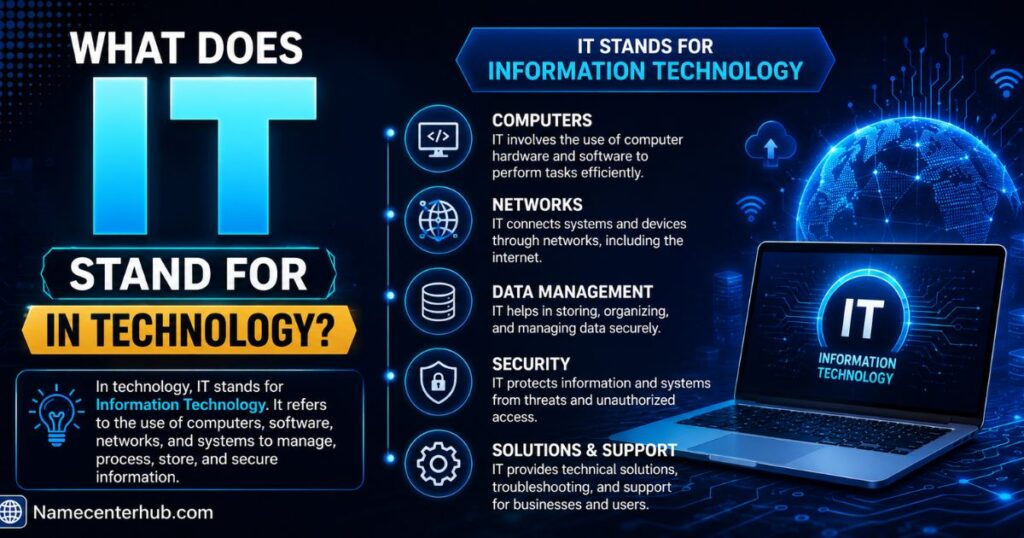
In a general technology context, “IT” stands for Information Technology :the entire field covering computers, software, networks, and data systems used to store, process, and share information.
It is a broad umbrella term that includes hardware maintenance, software development, cybersecurity, cloud services, and technical support, making it one of the most widely used abbreviations in the modern workplace.
The term became common once computers moved from purely scientific use into everyday business operations, since companies needed a single word to describe everything related to managing digital information. Today, “IT” appears in job titles, department names, and industry reports as shorthand for this entire technology ecosystem.
What Does IT Stand For in Computers?
In a computer-specific setting, IT still means Information Technology, but it usually refers narrowly to the systems, devices, and processes that keep computers running and connected.
This includes managing hardware, installing software, maintaining networks, and protecting data :tasks typically handled by an “IT department” or “IT support” team within a company.
When someone says “call IT,” they usually mean the team responsible for fixing computer issues, resetting passwords, or setting up new devices, rather than the broader academic or industry-wide meaning of the term.
What Does It Stand For in University?
As a university degree or department name, IT again stands for Information Technology, a program focused on practical computer systems, networking, databases, and applied software skills.
It is often compared with Computer Science and Information Systems, but the three programs have different focuses, which is worth understanding before choosing one.
| Program | Primary Focus |
| Information Technology (IT) | Practical systems, networking, hardware, IT support |
| Computer Science (CS) | Programming theory, algorithms, software engineering |
| Information Systems (IS) | Business processes combined with technology |
Students choosing between these programs often base their decision on whether they prefer hands-on system management, theoretical programming, or a business-focused blend of both.
IT degrees typically include coursework in networking, database administration, and technical support, preparing graduates for roles that keep an organization’s technology running smoothly.
What Does It Stand For in Computer Science?
Within computer science, “IT” is usually used the same way :Information Technology :but computer science students may encounter it less often, since CS leans more toward programming, algorithms, and theoretical computing rather than applied systems management.
Some computer science courses do overlap with IT topics, especially in networking, databases, and operating systems classes, which is why the two fields are often mentioned together.
Computer science graduates are more likely to work as software developers, algorithm designers, or systems engineers, while IT graduates are more likely to work in system administration, technical support, or infrastructure management. Both fields rely on similar foundational knowledge but apply it toward different career paths.
What These Technology Abbreviations Stand For in Daily Life
Beyond IT itself, dozens of shorter tech abbreviations show up constantly in browsers, emails, and apps without much explanation.
Most people use these terms daily without ever needing to know the full phrase behind them, but recognizing the meaning makes troubleshooting and communication noticeably easier.
Internet and Web Terms
- URL :Uniform Resource Locator, a web address
- HTTP/HTTPS :HyperText Transfer Protocol (Secure), used to load web pages
- WWW :World Wide Web
- ISP :Internet Service Provider
- Wi-Fi :a trademarked term for wireless networking, not a strict acronym
What CC, BCC, and SMTP Stand For in Communication
- CC :Carbon Copy, sends a visible copy of an email to others
- BCC :Blind Carbon Copy, sends a hidden copy so recipients cannot see each other
- SMTP :Simple Mail Transfer Protocol, the system used to send emails between servers
Understanding these terms is especially useful in professional email etiquette, where using CC or BCC incorrectly can accidentally expose someone’s email address or leave important recipients out of a conversation.
Technology & IT Abbreviations in Computer Hardware
Hardware-related abbreviations describe the physical parts of a computer and how they function together.
Input and Output Devices
- CPU :Central Processing Unit, the computer’s main processor
- GPU :Graphics Processing Unit, handles visual rendering
- RAM :Random Access Memory, temporary working memory
- SSD/HDD :Solid State Drive / Hard Disk Drive, storage devices
- USB :Universal Serial Bus, a common connection standard
- HDMI :High-Definition Multimedia Interface, used to connect displays and monitors
Knowing these terms helps when buying a laptop or troubleshooting slow performance, since specs are almost always listed using these abbreviations.
For example, a device with more RAM can multitask more smoothly, while an SSD generally loads programs faster than an older HDD, which is why comparing these specs matters more than comparing brand names alone.
Technology & IT Abbreviations in Software
Software abbreviations cover the programs and systems that run on hardware.
Operating System Terms
- OS :Operating System, the core software managing a device
- GUI :Graphical User Interface, the visual way users interact with software
- CLI :Command Line Interface, a text-based way to control a system
File Types and Formats
- PDF :Portable Document Format
- JPEG/PNG :common image file formats
- ZIP :a compressed file format used to bundle multiple files
Recognizing file formats helps you choose the right software to open a file and understand why some files are much smaller than others, since compressed formats like ZIP reduce file size for easier sharing and storage.
Technology & IT Abbreviations in Networking
Networking terms describe how devices connect and communicate with each other.
What LAN, WAN, and VPN Stand For in Networking
- LAN :Local Area Network, a network within one building or location
- WAN :Wide Area Network, a network spanning large distances
- VPN :Virtual Private Network, encrypts and secures internet traffic
These distinctions matter most when setting up home or office networks, since a LAN typically connects devices within a single building using Wi-Fi or ethernet cables, while a WAN connects multiple locations, sometimes across entire countries.
Security Terms
- VPN is also considered a security tool, alongside:
- firewall :a system that blocks unauthorized network access
- 2FA :Two-Factor Authentication, an extra login verification step
- DDoS :Distributed Denial of Service, a type of cyberattack
These security abbreviations are worth knowing beyond the workplace too, since enabling 2FA and using a VPN on public Wi-Fi are two of the simplest ways everyday users can protect personal accounts and data.
Technology & IT Abbreviations in Cloud Computing
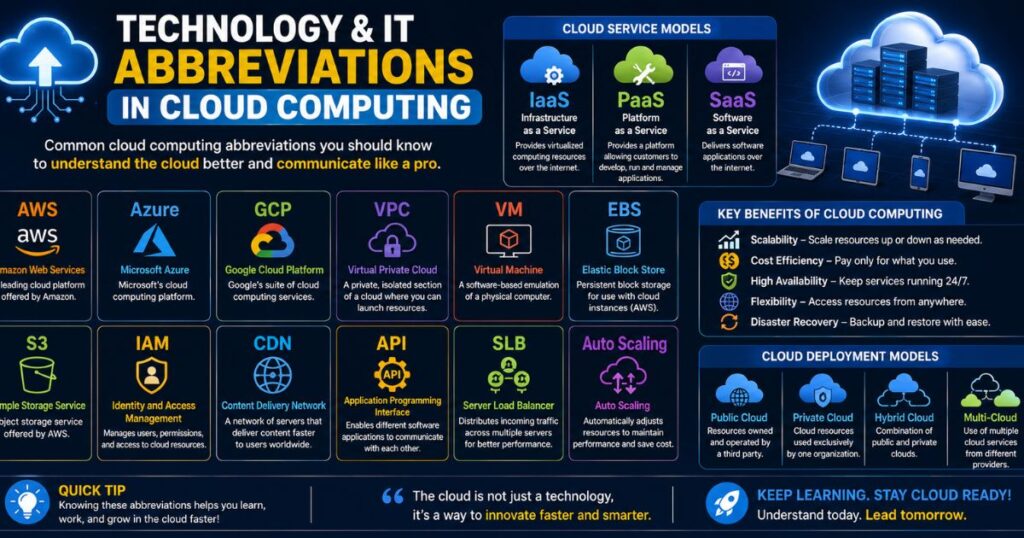
Cloud computing terms describe services delivered over the internet rather than stored locally.
Cloud Service Models
| Model | Stands For | What It Provides |
| SaaS | Software as a Service | Ready-to-use software over the internet |
| PaaS | Platform as a Service | Tools to build and deploy applications |
| IaaS | Infrastructure as a Service | Virtual servers, storage, and networking |
These three models represent increasing levels of control and responsibility. SaaS requires no technical setup from the user, PaaS gives developers a foundation to build on, and IaaS offers the most flexibility for businesses managing their own virtual infrastructure.
What API, CDN, and SLA Stand For in Cloud Computing
- API :Application Programming Interface, lets software systems communicate
- CDN :Content Delivery Network, speeds up content loading across regions
- SLA :Service Level Agreement, a guarantee of service uptime and performance
APIs are especially important in modern apps, since most services :from weather widgets to payment systems :rely on APIs to pull information from another platform without building that functionality from scratch.
Technology & IT Abbreviations in Programming
Programming abbreviations refer to the languages and tools developers use daily.
What HTML, CSS, JS, and SQL Stand For in Programming
- HTML :HyperText Markup Language, structures web pages
- CSS :Cascading Style Sheets, styles web pages
- JS :JavaScript, adds interactivity to websites
- SQL :Structured Query Language, manages and queries databases
These four terms together cover most of what makes a website function: HTML builds the structure, CSS controls the appearance, JavaScript adds interactivity, and SQL manages the data behind the scenes.
Development Tools
- IDE :Integrated Development Environment, software for writing and testing code
- API :reused here for connecting programs and services
- Git :a version control system (not an acronym, but frequently grouped with dev terms)
An IDE combines several tools developers need into one program, such as a code editor, debugger, and testing environment, which speeds up the process of writing and fixing software.
Technology & IT Abbreviations in Business Tech
Workplace technology comes with its own shorthand, often mixing tech and business language.
Office and Company Terms
- CTO :Chief Technology Officer
- CIO :Chief Information Officer
- ERP :Enterprise Resource Planning, software managing core business processes
- CRM :Customer Relationship Management, software for tracking customer interactions
These roles and systems often work together in larger companies, where a CTO oversees technical strategy while ERP and CRM software handle the daily operational and customer-facing workload.
Marketing Technology
- SEO :Search Engine Optimization
- CTR :Click-Through Rate
- KPI :Key Performance Indicator
These marketing metrics rely heavily on the same underlying technology infrastructure covered earlier, since tracking KPIs and CTR usually requires data collected through websites, apps, and cloud-based analytics tools.
Technology & IT Abbreviations in Mobile Technology
Mobile-specific abbreviations describe how smartphones connect and function.
What LTE, 5G, and SMS Stand For in Mobile Tech
- LTE :Long-Term Evolution, a 4G mobile network standard
- 5G :fifth-generation mobile network technology
- SMS :Short Message Service, standard text messaging
Mobile network generations like LTE and 5G determine how fast data loads on a phone, with each new generation generally offering higher speeds and better reliability for streaming, gaming, and video calls.
App Terms
- APK :Android Package Kit, an app installer file for Android
- UI/UX :User Interface / User Experience, how an app looks and feels to use
- RAM usage and OS version are commonly listed in app requirements, tying mobile terms back to hardware and software basics.
Understanding UI and UX separately is particularly useful, since UI refers to the visual layout of an app while UX refers to how smooth and intuitive the overall experience feels, and both directly affect how likely users are to keep using an app.
Technology & IT Abbreviations Trusted Learning
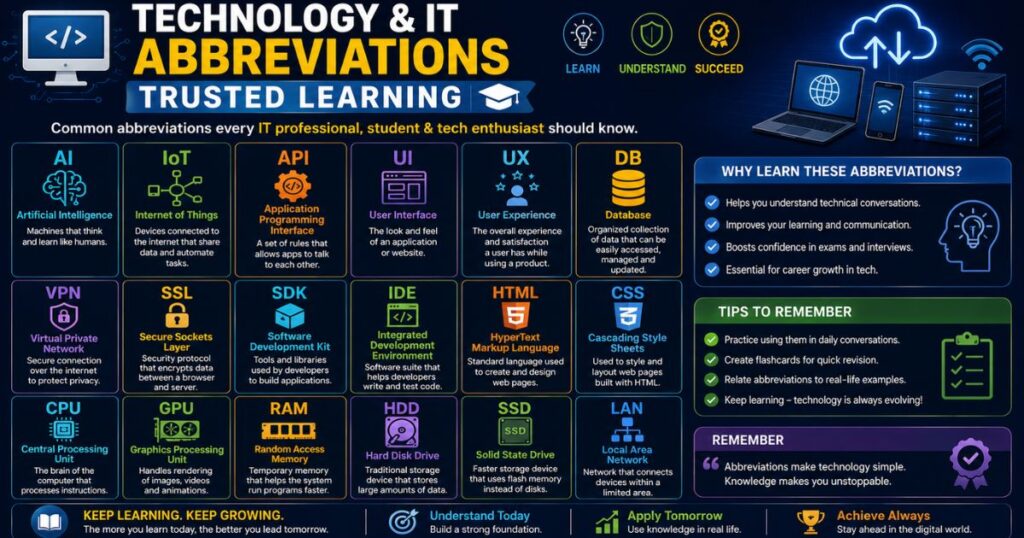
Learning tech abbreviations is easiest when definitions come from reliable, consistent sources rather than random forum posts.
Official documentation from operating system providers, university course catalogs, and established tech glossaries tend to use these terms the same way across contexts, which reduces confusion.
- Cross-check unfamiliar abbreviations against more than one reliable source
- Pay attention to context, since some abbreviations (like API) repeat across categories
- Bookmark a glossary or reference page for quick lookups during work or study
Building this habit early makes it much easier to keep up as new tech terms emerge, since the underlying patterns behind most abbreviations stay consistent even as specific technologies change.
Frequently Asked Questions
What does IT stand for in general?
IT stands for Information Technology, covering computers, software, networks, and data systems.
Is IT the same as computer science?
No, IT focuses on applied systems and support, while computer science focuses on programming and theory.
What does API stand for?
API stands for Application Programming Interface, allowing different software systems to communicate.
What is the difference between LAN and WAN?
LAN covers one location, while WAN connects networks across larger distances.
What does SaaS mean in cloud computing?
SaaS stands for Software as a Service, meaning ready-to-use software accessed online.
Why do so many tech terms use abbreviations?
Abbreviations save time in fast-paced technical communication and documentation.
Where can I check unfamiliar tech abbreviations?
Official product documentation, university resources, and established tech glossaries are the most reliable sources.
Conclusion
Most tech abbreviations trace back to a small set of recurring root words like Information, Network, System, and Interface, which makes them easier to recognize once you know the pattern.
Whether it is IT on a university course list or API inside a developer’s documentation, context is usually enough to confirm the exact meaning.