
If you have seen “POV” in a text, meme, caption, or social media post, you may wonder what it means. POV stands for “Point of View,” but its online use can be more casual.
In texting, it can describe someone’s perspective, introduce a situation, or ask you to imagine yourself in a particular moment. The meaning often depends on the words that come after it and the context of the conversation.
For Gen Z users, POV is especially common in short captions, funny posts, relatable videos, and chats. Understanding the basic meaning makes it much easier to understand comments and messages. This guide explains POV mean in text with simple meanings, real examples, common mistakes, and useful replies.
POV Mean in Text: Quick Meaning
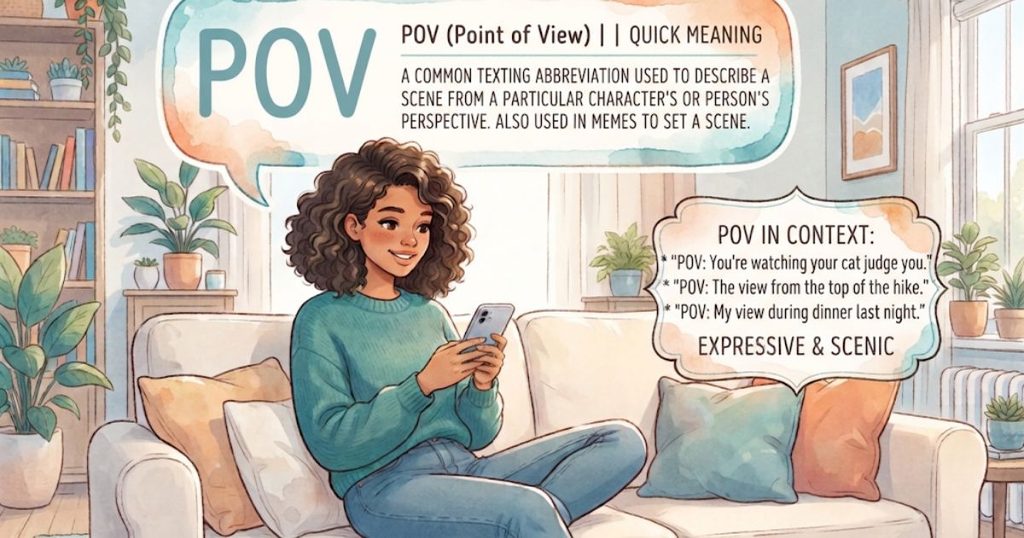
POV means “Point of View.” In text messages, it can refer to someone’s perspective or introduce a situation that the reader is expected to imagine.
For example:
“POV: You finally finish your homework at midnight.”
This does not necessarily mean someone is literally filming from their eyes. Instead, it creates a situation and invites you to imagine being there.
Another example is:
“From my POV, you handled it well.”
Here, POV clearly means someone’s personal perspective.
Simple breakdown:
P means Point
O means Of
V means View
So, the basic POV meaning is Point of View.
Online, however, the phrase has developed a flexible use. People often put POV at the beginning of a sentence to quickly create a scene.
It can make a message feel more conversational and relatable. Instead of explaining an entire situation, a person can use three letters and then describe the moment.
Quick examples:
• POV: You wake up five minutes before class. 😭
• POV: Your friend says “I’m outside” but they are still at home. 😂
• POV: You finally get the reply you were waiting for. 👀
• POV: Everyone forgot there was a test today.
• From my POV, the plan makes sense.
The first examples create imaginary or relatable situations. The last example uses POV in its more traditional sense of personal perspective.
Origin & Background
POV is short for Point of View, a phrase that has long been used to describe perspective.
In writing, point of view can describe who is telling or experiencing a story. In film and photography, it can refer to the perspective from which a scene is presented.
Online communication made POV much more compact and flexible.
Instead of writing a long explanation such as “Imagine you are in this situation,” someone can simply write “POV:” and describe the moment.
This format works particularly well for social media because people often consume short captions, videos, memes, and comments quickly.
Over time, POV became closely associated with relatable scenarios, comedy, role play, storytelling, and everyday situations.
The important thing to remember is that the modern internet use does not completely replace the original meaning. Both meanings can exist at the same time.
Real Life Conversations
POV can appear in different types of online conversations. The exact tone changes depending on the platform and the people talking.
WhatsApp Chat
In a WhatsApp conversation, POV is usually casual.
Someone might send:
Friend: POV: You said you would sleep early.
You: And now it’s 2 AM 😂
Here, POV introduces a relatable situation rather than asking a direct question.
It can also be used more literally:
“From my POV, we should wait until tomorrow.”
In this case, the sender is explaining their perspective.
Instagram DMs
In Instagram DMs, POV may appear when someone shares a Reel, meme, or funny post.
For example:
“POV: You open Instagram for five minutes and stay for two hours.”
A friend might send this because the situation feels familiar.
The person receiving it does not need to explain what POV means. The phrase simply sets up the joke or scenario.
TikTok Comments
POV is common in short form video conversations.
A comment might say:
“POV from the back row.”
Or:
“POV: You watched this three times.”
The meaning depends on the rest of the comment. The abbreviation helps establish a perspective quickly.
Text Messages
In ordinary texting, POV can be used for both perspective and imaginary situations.
For example:
“POV: You forgot your phone at home.”
Or:
“What’s your POV on this?”
The first creates a situation. The second asks for someone’s viewpoint.
Emotional & Psychological Meaning
POV can make a message feel more personal because it asks the reader to place themselves inside a situation.
Consider:
“You are late to class.”
Now compare it with:
“POV: You are late to class and everyone looks at you.”
The second version creates a stronger scene. It gives the reader a role and encourages them to imagine what the moment feels like.
That is why POV works well for funny, emotional, awkward, dramatic, or relatable content.
A simple real life scenario:
Imagine someone has been waiting all day for a message from a friend.
They could write:
“I finally got the message.”
Or they could write:
“POV: You have been waiting all day and they finally reply.”
The second version turns the experience into a scene that other people can recognize.
POV can therefore help communicate emotions such as excitement, embarrassment, frustration, surprise, or humor without explaining every detail.
Usage in Different Contexts
The same abbreviation can work differently depending on the situation.
Social Media
On social media, POV often introduces a scenario.
Common examples include:
• POV: It’s finally Friday. 🎉
• POV: Your favorite song starts playing. 🎧
• POV: You see your crush unexpectedly. 👀
• POV: The teacher says there is no homework. 😌
The purpose is usually to make the audience imagine the situation.
Friends & Relationships
Friends may use POV to describe shared experiences.
For example:
“POV: We said we would leave early.”
The friend reading it understands that the message is probably connected to something they both experienced.
It can also be used in relationship conversations when describing emotional situations.
“POV: You finally tell them how you feel.”
The meaning remains centered around perspective and experience.
Work / Professional Settings
POV can sometimes appear in workplace conversations, especially in informal chats.
For example:
“From my POV, the deadline is too close.”
However, using abbreviations in formal emails, reports, official documents, or professional presentations may not always be appropriate.
Writing “From my point of view” can be clearer when communicating with people who may not be familiar with internet abbreviations.
Casual vs Serious Tone
POV can be funny or serious.
A casual example is:
“POV: You open the fridge for the fifth time.” 😂
A serious example is:
“From my POV, we need to consider both sides.”
The words surrounding POV usually tell you which meaning is intended.
When NOT to Use It
POV is useful in casual communication, but it does not fit every situation.
Avoid using it:
• In formal academic writing
• In official documents
• In serious professional reports
• When the audience may not understand the abbreviation
• When a clearer phrase would communicate the idea better
For example, writing “POV: The company needs a new strategy” in a formal report may sound less appropriate than simply saying “From this perspective, the company needs a new strategy.”
The goal is not to avoid POV completely. The goal is to match the language to the audience.
Common Misunderstandings
POV is simple once you understand the context, but several misunderstandings are common.
1. Thinking it always means “your perspective”
POV does not always mean that the reader’s personal opinion is being requested.
When someone writes:
“POV: You walk into school late.”
They are creating a scenario.
But when someone says:
“What’s your POV?”
they are asking for your perspective.
2. Using it without a clear situation
A POV caption works better when the situation is easy to understand.
For example:
“POV: Monday.”
This is vague by itself.
But:
“POV: It’s Monday and your alarm rings after three hours of sleep.”
creates a much clearer picture.
3. Confusing tone
POV can be funny, serious, emotional, sarcastic, or dramatic.
The abbreviation itself does not determine the tone.
You need to look at the complete message, caption, image, or video.
4. Overusing it
Using POV in every caption can make the format feel repetitive.
It works best when it adds something useful to the situation.
If the sentence is already clear without POV, there may be no reason to add it.
POV Meaning Compared With Similar Terms
| Term | Basic Meaning | Common Use |
| POV | Point of View | Perspective or imagined scenario |
| Opinion | Personal belief or judgment | Sharing what you think |
| Perspective | A particular way of seeing something | Explaining a viewpoint |
| Viewpoint | Someone’s position or opinion | Discussions and arguments |
| Scenario | A possible situation | Imaginary or planned events |
These terms can overlap, but they are not identical.
POV is an abbreviation that can describe perspective or introduce a scenario. Opinion is more specifically about what someone believes or thinks.
Key Insight
The easiest way to understand POV is to ask one question:
“Whose perspective or situation is being presented?”
If the answer is clear, the meaning of POV usually becomes obvious.
Variations and Types of POV
POV can appear in several forms online.
Personal POV
This refers directly to someone’s perspective.
“From my POV, this was the right choice.”
Scenario POV
This introduces a situation for the reader to imagine.
“POV: You forgot your assignment.”
Funny POV
This uses an everyday situation to create humor.
“POV: You say you are going to sleep early.” 😂
Emotional POV
This creates an emotional moment.
“POV: You hear your childhood favorite song again.”
Roleplay POV
This places the audience into a character or situation.
“POV: You are the new student on your first day.”
These variations show why POV is so flexible in digital communication.
How to Respond When Someone Uses It
There is no single correct response to a POV message. Your reply should match the situation.
Casual Replies
If the message is relatable, you can respond naturally.
• “Literally me.” 😂
• “That’s so true.”
• “This happens every time.”
Funny Replies
If the POV is clearly a joke, continue the humor.
• “And somehow I still do it.” 😂
• “Why is this so accurate?”
• “Caught me.” 😭
Mature Replies
If the person is discussing a serious perspective, respond directly.
• “I understand your point.”
• “That makes sense from your perspective.”
• “I see why you feel that way.”
Respectful Replies
If someone asks for your POV, give your actual viewpoint instead of assuming what they want to hear.
For example:
“From my perspective, both sides have valid points.”
This keeps the conversation clear and respectful.
Regional & Cultural Usage
POV is widely recognizable in online communication, but people can use it differently depending on age, platform, and communication style.
Western Culture
In many English speaking online communities, POV is common in memes, captions, short videos, and casual messages.
It often introduces humor or relatable situations.
Asian Culture
English internet abbreviations are also common among many social media users in Asian online spaces.
POV may appear in captions, comments, group chats, and short form videos, especially when users communicate partly or entirely in English.
Middle Eastern Culture
POV can also appear in English language social media content and casual online communication.
The surrounding language may change, but the abbreviation can remain recognizable.
Global Internet Usage
Because social media connects users across countries, abbreviations such as POV can cross language and cultural boundaries.
A person may understand the abbreviation even when the rest of the post is written in another language.
Generational Differences
Younger users may recognize POV immediately because of frequent exposure to social media.
Older users may know the traditional meaning but may not immediately recognize its newer meme style.
This is why context matters when using internet abbreviations with different age groups.
Why POV Works So Well in Short Content
One reason POV fits modern social media is that it communicates an idea very quickly.
A short phrase can establish the setting before the viewer even sees the full content.
For example:
“POV: Your friend says they are five minutes away.”
The audience immediately understands the setup.
POV also encourages recognition. When people see a situation that feels familiar, they may comment, share, or send it to a friend.
This makes the format especially useful for short videos, memes, captions, and casual messages.
The strongest POV examples usually have three things:
• A clear situation 👀
• A recognizable emotion
• A perspective the audience can understand
How to Use POV Naturally in Text
If you want to use POV in your own messages, keep the sentence simple.
Start with “POV:” and describe the situation.
For example:
“POV: You finally finish everything on your to do list.”
You can also use POV inside a normal sentence.
“From my POV, we should wait.”
Do not force the abbreviation into every message.
If the situation needs a full explanation, write the explanation. POV is useful because it makes communication shorter, not because every sentence needs internet slang.
Is POV Safe for Kids?
POV itself is simply an abbreviation for “Point of View.” The abbreviation is not inherently harmful.
However, the content attached to a POV caption can vary widely.
Parents and younger users should consider the full context of a post rather than judging the abbreviation itself.
A harmless example might be:
“POV: You forgot your lunch.”
Another post could involve a mature topic while using the same abbreviation.
So, the safety question is usually about the content surrounding POV rather than the letters themselves.
Frequently Asked Questions
What does POV mean in texting?
POV usually means “Point of View.” In texting, it can describe someone’s perspective or introduce an imagined situation.
Is POV always used correctly online?
Not always. Social media users often use POV loosely to introduce relatable, funny, or imaginary situations.
Can I use POV in formal writing?
You can, but spelling out “Point of View” or using clearer formal wording is usually more appropriate for professional and academic writing.
Why is POV so popular?
POV quickly establishes a perspective or scenario, making it useful for short messages, memes, captions, and social media content.
Is POV only used on TikTok?
No. POV can appear in texts, Instagram content, WhatsApp chats, memes, comments, videos, and many other online spaces.
Can POV be serious?
Yes. POV can describe a serious personal perspective, such as “From my POV, we need to reconsider the decision.”
Does POV always mean an opinion?
No. POV means point of view, which can describe a perspective, experience, narrative angle, or imagined situation.
Conclusion
POV means “Point of View,” but its use in online communication is broader than a simple dictionary definition. In texts and social media, it can introduce a situation, describe a perspective, or invite someone to imagine a particular moment. You may see it in memes, captions, comments, DMs, group chats, and short videos.
The meaning becomes clear when you look at the words that follow POV and the overall tone of the message. For casual conversations, POV is a short and familiar way to frame an idea. Once you understand the context, recognizing and using POV becomes simple and natural.