
Safra Catz and John Stankey have spent decades running two of the most important companies in American business. Catz led Oracle for eleven years before moving to a board role in 2025. Stankey has led AT&T since 2020 and still holds the top seat in 2026.
They are not celebrities in the Hollywood sense. Their decisions still shape cloud computing, artificial intelligence, mobile networks, and home internet across the globe. This guide covers their backgrounds, careers, and current roles using confirmed facts, and it flags anything that is disputed or unclear.
Quick Bio Table
| Detail | Safra Catz | John Stankey |
| Full name | Safra Ada Catz | John Thomas Stankey |
| Current role (October 2026) | Executive Vice Chair, Oracle | Chairman and CEO, AT&T |
| Age | 64 | Birth date not officially published |
| Born | December 1961, Holon, Israel | Not officially published |
| Nationality | Israeli-American (US citizen) | American |
| Education | University of Pennsylvania (bachelor’s and law degree) | Loyola Marymount University (BBA, Finance); UCLA (MBA) |
| Joined current company | April 1999 | 1985 |
| Top-job tenure | Oracle CEO 2014–2025 (sole CEO from 2019) | AT&T CEO since July 2020; chairman since February 2025 |
| Industry | Enterprise software, cloud, AI | Telecommunications, fiber, wireless |
| Net worth | Not officially disclosed; estimates vary | Not officially disclosed; estimates vary |
Safra Catz: Who She Is and What She Is Known For
Safra Catz is an Israeli-American business executive. She became Oracle’s executive vice chair in September 2025 and was succeeded as CEO by co-CEOs Clay Magouyrk and Mike Sicilia.
She is known for finance discipline, large acquisitions, and a very low public profile. Colleagues have long described her as the executive who turns Larry Ellison’s ideas into working business plans.
Her name carries weight in global technology circles. Oracle sells software and cloud services in more than 175 countries, so her decisions reach customers far beyond the United States.
Safra Catz’s Early Life and Educational Background
Catz was born in Holon, Israel, in December 1961. Her family moved to the United States when she was a child.
She studied at the University of Pennsylvania and earned both a bachelor’s degree and a law degree there. Few technology chiefs hold a law degree, and it shaped her careful, contract-focused style.
The exact day of her birth appears as December 1 in some profiles and December 13 in others. Only the month and year are consistent, so treat the day as unconfirmed.
Her Transition From Investment Banking to Technology Finance
Catz began her career in investment banking in 1986. She joined Donaldson, Lufkin & Jenrette and worked her way up to managing director by 1997.
Her client work centered on technology companies. That gave her a close view of how software firms earn revenue, spend on research, and use deals to grow.
This background explains her later habits at Oracle. She read every deal as a financial return problem first and a technology story second.
From Wall Street to Oracle’s Boardroom
Larry Ellison recruited her to Oracle, and she joined in April 1999 as a senior vice president. Within months she became an executive vice president.
She joined the board in 2001. The move from Wall Street to a software boardroom took only two years, which shows how quickly Ellison came to rely on her.
Over the years she also served on the boards of HSBC and Disney. Those seats gave her a wider view of global banking and media.
How Safra Catz Built Her Career at Oracle
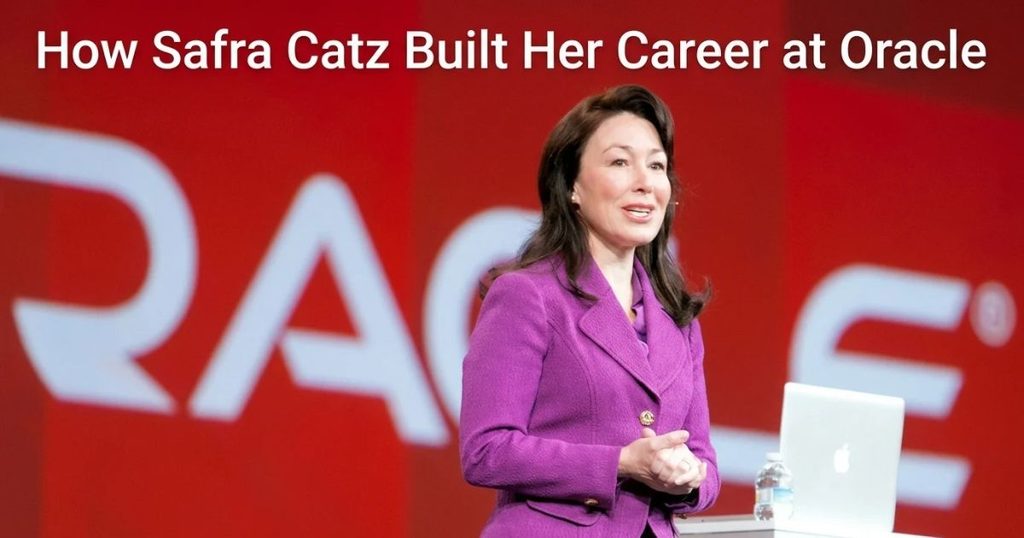
Catz spent more than 25 years at Oracle in finance, operations, and eventually the top job. Her career there falls into clear stages: deal-maker, finance chief, co-CEO, and sole CEO.
| Year | Milestone |
| 1999 | Joins Oracle as senior vice president |
| 2001 | Elected to the board of directors |
| 2004 | Named president |
| Early 2005 | PeopleSoft acquisition completes |
| 2014 | Becomes co-CEO with Mark Hurd |
| 2019 | Becomes sole CEO |
| September 2025 | Moves to executive vice chair |
Her Arrival at Oracle and the PeopleSoft Acquisition
PeopleSoft was the defining early test. Oracle pursued the rival software maker in a long, public, hostile contest that ended with a deal worth about $10.3 billion.
The takeover removed a direct competitor in business applications. It also showed that Oracle could absorb a large company and keep its customers.
Catz later served as chief financial officer, and the company’s finances ran through her office. That control is a big reason Ellison trusted her with larger deals.
Safra Catz’s Acquisition Strategy Explained
Her approach was simple and repeatable. Buy a product that fits Oracle’s stack, cut overlapping costs, and fold the customers into existing contracts.
Major deals followed over the years:
- Sun Microsystems in 2010, which gave Oracle hardware and the Java language.
- NetSuite in 2016, which brought cloud-based business software.
- Cerner in 2022, which pushed Oracle into healthcare records.
Critics said the strategy relied too heavily on buying growth instead of inventing it. Supporters pointed to steady margins and loyal enterprise customers.
Her Rise From Co-CEO to Sole CEO
In September 2014, Catz and Mark Hurd became co-CEOs, while Ellison moved to executive chairman and chief technology officer. The structure let Ellison focus on technology while the two executives ran the business.
Hurd took a health-related leave in 2019 and died later that year. Catz then continued as the sole chief executive.
The transition was calm. Oracle did not announce a major strategy change, which fits the steady style she was known for.
Steering Oracle Into Cloud Computing and AI
Oracle arrived late to cloud computing compared with larger rivals. Under Catz, the company built Oracle Cloud Infrastructure and bet that AI developers would need large amounts of computing power.
That bet paid off in a visible way. In September 2025, Oracle reported a surge in contracted future revenue, and its shares jumped sharply that month.
The jump followed the earnings report, not the leadership announcement. The two events are often confused, so it helps to keep them separate.
Her 2025 Shift to the Executive Vice Chair Role
Oracle named Clay Magouyrk and Mike Sicilia co-CEOs in September 2025, with Catz moving to executive vice chair while staying on the board. Magouyrk ran Oracle Cloud Infrastructure, and Sicilia led the industry applications business.
Catz described the moment as a time of strength and the right point to pass the role to a new generation. Nothing in the public record points to a forced exit.
Claims that she was pushed out are speculation, not confirmed fact. The board statement, her own words, and her continued board seat all point to a planned handoff.
John Stankey: Who He Is and What He Is Known For
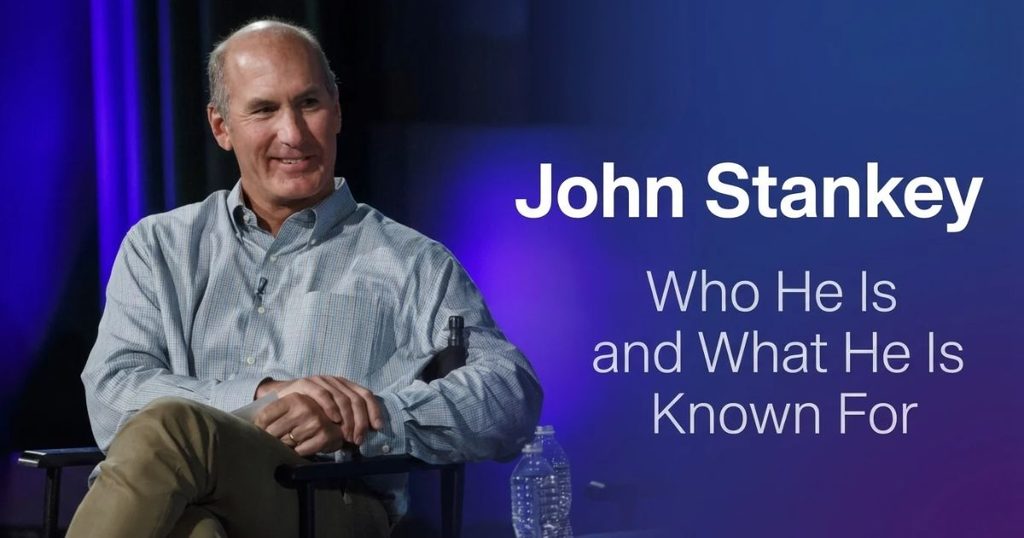
John Stankey is the chairman and chief executive of AT&T. He has led the company as CEO and president since July 2020 and was elected chairman in February 2025.
He is known for operational depth rather than deal-making. His career runs through almost every function at AT&T, and he is most associated with pulling the company back to its network business.
AT&T serves tens of millions of households and businesses, so his choices affect everyday phone and internet service for a very large audience.
John Stankey’s Early Life and Education
Stankey earned a Bachelor of Business Administration in Finance from Loyola Marymount University. He later completed an MBA at UCLA.
Detailed accounts of his childhood and family are not part of the official record. We leave them out rather than repeat unverified claims.
What is confirmed is his education, which was business-focused and finance-heavy. It matches the numbers-driven side of his later leadership.
A Career Built Entirely at One Company
Stankey started at AT&T in 1985, and the company’s official biography counts roughly 40 years of service. The business changed shape many times during that period, through mergers and rebrands.
Because of those mergers, his first employer was a predecessor company rather than today’s AT&T. That is standard for long-serving telecom executives.
Few leaders can say they have worked inside the same corporate family for four decades. That history gives him deep knowledge of how the network actually runs.
A Four-Decade AT&T Insider
Stankey has worked in business services, operations, technology, strategy, entertainment, and media. That breadth is the main reason the board chose him in 2020.
He understood how the network, the customer, and the finances connect. He also knew where the company had made mistakes, including in media.
Being an insider has a downside. Critics argue that long-serving leaders can struggle to challenge old habits, though his divestitures suggest otherwise.
John Stankey’s Rise Through the Ranks at AT&T
Stankey’s climb was gradual, and each role widened his view of the company. According to the company’s own biography, he held these positions over the years:
- CEO of AT&T Business Solutions
- CEO of AT&T Operations
- Chief Technology Officer
- Chief Strategy Officer
- CEO of AT&T Entertainment Group
- CEO of WarnerMedia
- Chief Operating Officer
Advancing From CIO to CTO to Chief Strategy Officer
His senior technology roles, including chief information officer and chief technology officer, taught him how large networks and systems are built and paid for.
The chief strategy role then put him in charge of long-range planning across the whole company. Those jobs gave him the vocabulary to speak with both engineers and investors.
His Leadership of WarnerMedia
AT&T completed its purchase of Time Warner in 2018, and Stankey was put in charge of the media business. The unit included HBO, Warner Bros., and Turner, and he oversaw the launch of the HBO Max streaming service in 2020.
The strategy aimed to combine content with distribution. It did not deliver the returns the company had hoped for.
His Appointment as AT&T CEO and Chairman
Randall Stephenson retired in 2020, and Stankey succeeded him as chief executive on July 1. In February 2025, the board elected him chairman, with William Kennard becoming lead independent director.
Holding both roles gives him a wide mandate over strategy and capital allocation. It also places more accountability on one person.
Divesting AT&T’s Media Business
Stankey reversed the media strategy. In 2021, AT&T moved DirecTV into a venture with TPG, and in 2024 it agreed to sell its remaining stake for about $7.6 billion.
In 2022, WarnerMedia merged with Discovery to form Warner Bros. Discovery. AT&T received about $40 billion in cash and debt relief, and its shareholders received a majority stake in the new company.
How John Stankey Has Transformed AT&T
The company he runs in 2026 is narrower and more focused. AT&T reports more than $125 billion in 2025 revenue and over 100 million US subscribers across wireless and broadband.
His changes fall into four areas.
Putting the Customer First
A major network outage in February 2024 damaged trust, and the company offered customers credits afterward. Stankey has since framed service reliability and customer experience as the center of the business.
The practical shift is that product and network decisions now begin with what customers notice, such as dropped calls and slow home internet.
Integrating AI Into Products and Operations
AT&T has built internal generative AI tools for employees, including help with customer service and software work. Stankey treats AI as an operating tool, not a side project.
The goal is lower cost and faster service. It is less about launching new consumer gadgets.
Prioritizing In-Person Collaboration
AT&T has pushed many employees toward more time in the office. Stankey’s view is that hard problems get solved faster when teams share a room.
This stance is debated. Supporters point to speed and culture, while critics point to flexibility and hiring.
Betting on Fiber and Wireless Networks
AT&T announced a deal in 2025 to buy Lumen’s consumer fiber business and another to acquire spectrum from EchoStar. Both aim to expand fiber homes and 5G capacity.
The common thread is ownership of the network. Stankey wants AT&T to control the pipes rather than the content that runs through them.
Safra Catz vs. John Stankey: A Side-by-Side Comparison
Both executives faced the same era of cloud computing, mobile networks, and AI. They still chose very different playbooks.
Catz expanded through acquisitions. Stankey tightened the company around its core.
Key Similarities Between Safra Catz and John Stankey
- Both spent decades inside one company’s leadership structure.
- Both lead organizations with global reach and heavy infrastructure spending.
- Both treat AI as a central business issue, not a side topic.
- Both have ties to the media world: Stankey ran WarnerMedia, and Catz has served on the boards of Disney and, per public listings, Paramount Skydance.
How Their Career Paths and Leadership Styles Differ
Catz came from investment banking and joined Oracle as an outsider in her late thirties. Stankey never left the AT&T family and rose through operations.
Catz is known for finance and acquisitions, and she works mostly out of public view. Stankey is known for operations and restructuring, and he speaks often to investors.
Oracle vs. AT&T Leaders: Comparison Table
| Category | Safra Catz | John Stankey |
| Company | Oracle (enterprise software, cloud, AI) | AT&T (wireless, fiber, broadband) |
| Background | Investment banking, law | Telecom operations, finance |
| Joined | 1999 (outsider) | 1985 (insider) |
| Top role | CEO 2014–2025; executive vice chair since 2025 | CEO since 2020; chairman since 2025 |
| Signature move | PeopleSoft and serial acquisitions | Exit from media, return to connectivity |
| Core bet | Cloud infrastructure and AI | Fiber and wireless networks |
| Public profile | Low | Moderate, investor-facing |
Why There Is No Clear Winner Between the Two Approaches
Each strategy fit a different problem. Oracle needed to grow beyond databases, so buying capabilities made sense.
AT&T had overreached into media and carried heavy debt, so simplifying made sense. Judging them against each other ignores that context.
Safra Catz and John Stankey in 2026: Where They Stand Today
One leader has stepped back from daily management, while the other is deep in execution. Both remain influential at companies that anchor the American economy.
Safra Catz’s Current Role in 2026
Oracle’s 2026 proxy statement lists Catz as executive vice chair, a director since 2001, at age 64. She chairs the Oracle Education Foundation and serves on the board of In-Q-Tel.
Oracle’s official biography also notes a teaching role at Stanford’s business school. Day-to-day operations now sit with the two co-CEOs, while Larry Ellison remains chairman and chief technology officer.
John Stankey’s Current Role in 2026
Stankey remains chairman and CEO. His priorities are fiber expansion, wireless growth, and the integration of recent acquisitions.
AT&T has also kept up heavy network spending. Its leadership describes the company as a focused connectivity provider.
What These Leadership Moves Mean for American Business
| Signal | What it suggests |
| Oracle’s co-CEO handoff | Confidence in a new generation to run cloud and AI |
| Catz staying on as executive vice chair | Continuity on strategy and finance |
| Stankey holding both CEO and chair roles | Concentrated authority at AT&T |
| AT&T’s fiber and spectrum deals | Long-term bet on owning the network |
How Oracle and AT&T Intersect: Compute Meets Connectivity
No public record shows a joint venture or direct partnership run by Catz and Stankey. Any claim of a personal business tie between them should be treated as speculation.
The link is structural. AI workloads need large data centers, and those data centers need fast, reliable fiber and wireless links to reach users.
Oracle supplies much of the computing power. AT&T supplies much of the connectivity. Their paths do not cross directly, but the businesses depend on the same wave of AI demand.
For readers in the United States, Europe, South Asia, and beyond, this matters because both companies serve global customers. Enterprise cloud and mobile networks now sit under almost every digital service people use.
Conclusion
Safra Catz and John Stankey represent two proven ways to lead a large American company. Catz built Oracle through acquisitions and cloud investment, then moved to executive vice chair in 2025. Stankey narrowed AT&T to its network and still runs it as chairman and CEO.
For anyone searching for their biography, age, or current role, the facts are clear. Catz is 64 and is no longer Oracle’s CEO, while Stankey has led AT&T since July 2020. Net worth figures for both remain estimates, not confirmed numbers.
Frequently Asked Questions
Who is Safra Catz, and what is she known for?
Safra Catz is an Israeli-American executive who led Oracle as CEO from 2014 to 2025. She is known for acquisitions such as PeopleSoft and for steering Oracle into cloud computing.
Is Safra Catz still the CEO of Oracle in 2026?
No. She became executive vice chair in September 2025. She remains on the board.
Who is John Stankey, and what does he do?
John Stankey is the chairman and CEO of AT&T. He oversees the company’s wireless, fiber, and broadband businesses.
How long has John Stankey served as CEO of AT&T?
He has been CEO since July 2020, which is more than six years as of October 2026. He also became chairman in February 2025.
What do Safra Catz and John Stankey have in common?
Both spent decades in senior roles at large companies and both have ties to the media industry. Both also lead businesses shaped by AI demand.
How do Safra Catz and John Stankey differ as business leaders?
Catz grew Oracle through acquisitions, while Stankey narrowed AT&T to its core network. She joined from outside, while he rose within the company.
Who replaced Safra Catz as CEO of Oracle?
Clay Magouyrk and Mike Sicilia replaced her as co-CEOs in September 2025. Catz moved to executive vice chair.