
If a text pops up on your phone with just “ILYSM” and nothing else, you might pause for a second before you figure out what it means. It happens to almost everyone the first time they see it.
ILYSM is one of the most common love-related acronyms in texting and social media, and it shows up everywhere from DMs to comment sections.
This guide breaks down exactly what ILYSM means, where people use it, how to reply to it, and how it compares to similar texting slang like ILY and ILYSFM. By the end, you will know exactly when it is appropriate to send, and when it might come across the wrong way.
What Does ILYSM Mean in Text?
ILYSM stands for “I Love You So Much.” It is a texting abbreviation that adds emphasis to the standard “I love you,” making the feeling sound stronger, warmer, or more heartfelt. People use ILYSM to express deep affection quickly, without typing out the full phrase every time.
Unlike some slang terms that carry hidden or sarcastic meanings, ILYSM is almost always sincere. It is used between romantic partners, close friends, and family members who want to express strong affection in a short, casual way.
Because texting favors speed, acronyms like ILYSM let people say something meaningful without slowing down the conversation.
Where Is ILYSM Commonly Used?
ILYSM is not limited to one app or platform. It shows up wherever quick, casual messaging happens, and its tone shifts slightly depending on where it is used.
Popular Platforms
ILYSM is most common on:
- Instagram: in DMs, comments, and story replies
- Snapchat: in chats and captions
- TikTok: in comment sections under emotional or wholesome videos
- iMessage and WhatsApp: in everyday texting between friends or partners
- Twitter/X: as a quick reply to something touching or funny
Tone and Style
Because it is short and informal, ILYSM fits naturally into casual conversations. It rarely appears in formal writing, emails, or professional messages. The tone is warm, quick, and low-effort in the best sense: it says a lot without demanding a long response.
Examples of ILYSM in Conversation
Seeing ILYSM in real conversation makes its meaning much clearer. Here are a few common examples:
- “Thanks for helping me move today, ILYSM.”
- “Happy birthday, ILYSM! Hope your day is amazing.”
- “I can’t believe you remembered, ILYSM.”
- “Missing you like crazy right now, ILYSM.”
In each case, ILYSM works as a quick emotional boost at the end of a message rather than the main point of the conversation.
When to Use and When Not to Use ILYSM
Timing and context matter with ILYSM, just like with any expression of affection. Using it well means reading the relationship and the moment correctly.
When to Use ILYSM
- Texting a close friend after they do something kind
- Messaging a partner during a sweet or emotional moment
- Replying to a family member on a birthday or holiday
- Commenting on a heartfelt social media post
When Not to Use ILYSM
- In professional or work-related messages
- With someone you are not close to, since it can feel too intense too soon
- As a sarcastic or joking reply, since it can confuse the other person
- In a first conversation with a new romantic interest, before real trust is built
Other Meanings of ILYSM in Text
While “I Love You So Much” is by far the most common meaning, ILYSM can occasionally appear with alternate meanings depending on context, such as:
- I Like You So Much: used in early-stage relationships before “love” feels appropriate
- I Love You Soooo Much: a playful, stretched-out variation used mostly for emphasis
These alternate meanings are rare, but context usually makes the intended meaning obvious. If someone you just met sends ILYSM, they most likely mean it in a lighter, “I like you” sense rather than a romantic declaration.
Similar Slang Words and Alternatives
ILYSM belongs to a small family of love-related texting acronyms. Here is how it compares to the most common ones.
| Acronym | Full Meaning | Typical Intensity |
| ILY | I Love You | Standard |
| ILYSM | I Love You So Much | Strong |
| ILYSFM | I Love You So Freaking Much | Very strong |
| ILU | I Love You | Standard, informal |
| ILYVM | I Love You Very Much | Strong |
Each of these acronyms carries a slightly different emotional weight, but they all serve the same basic purpose: expressing love quickly in a text-friendly format.
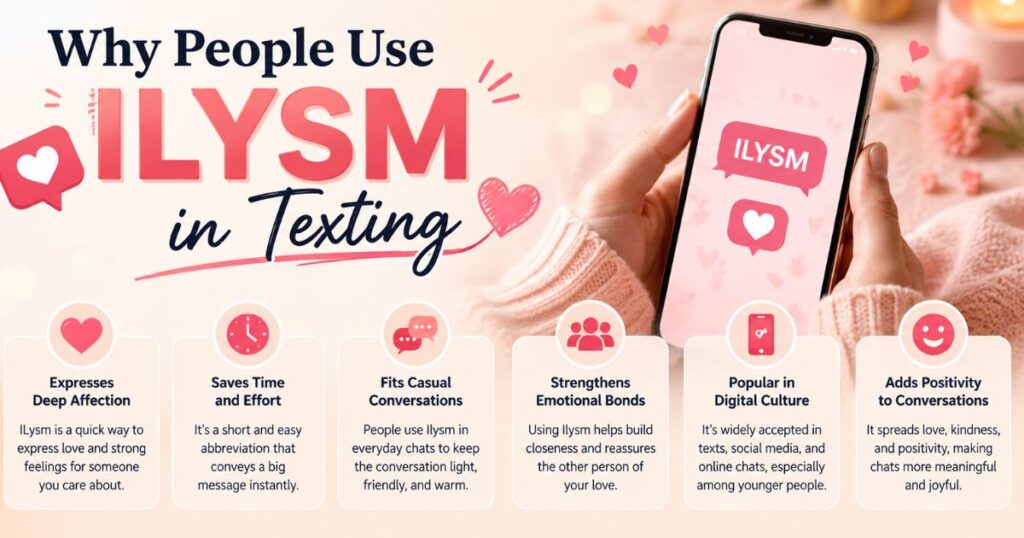
Why People Use ILYSM in Texting
Acronyms like ILYSM did not appear randomly. They developed because texting culture rewards speed, and shorthand fits that need perfectly.
Fast and Efficient
Typing four letters is faster than typing three words, especially on a small phone keyboard. In fast-paced conversations, ILYSM keeps the message moving without losing emotional meaning.
Convenient for Mobile Typing
Autocomplete and predictive text make acronyms even easier to send. Many people type ILYSM out of habit because it has become second nature on mobile keyboards.
Casual and Friendly
ILYSM feels lighter than a full sentence. It fits naturally into everyday texting without sounding overly formal or dramatic.
Social Media-Friendly
Short acronyms work well within character limits and fast-scrolling feeds. ILYSM fits perfectly into a comment, a caption, or a quick DM reply.
Flexible Across Relationships
Unlike some romantic phrases, ILYSM adapts to friendships, family relationships, and romantic ones alike, which makes it one of the most versatile love-related acronyms in texting.
Is ILYSM Friendly or Romantic?
One of the most common questions about ILYSM is whether it is meant romantically or platonically. The honest answer is that it depends entirely on who is sending it and the relationship behind the message.
Romantic Use
Between partners, ILYSM usually signals deep affection, appreciation, or reassurance. It often appears during sweet moments, after a date, or as a goodnight message.
Friendly Use
Between close friends, ILYSM expresses gratitude or platonic love. It is common after a friend does something kind, supportive, or thoughtful.
Playful Use
Sometimes ILYSM is used jokingly, especially in group chats or comment sections, to react to something funny or relatable rather than to express literal love.
ILYSM Meaning From a Girl vs From a Boy
Does ILYSM mean something different depending on who sends it? Not exactly, but the context around it often shifts based on the relationship dynamic.
When a girl sends ILYSM to a guy she is interested in, it often signals genuine romantic feelings, especially if it comes with other affectionate messages.
When a boy sends ILYSM, it can carry the same weight, though some guys use it more casually with friends as a joke or a sign of loyalty rather than romance. In both cases, the surrounding conversation is a better indicator of intent than the acronym itself.
How to Reply to ILYSM
Not sure how to respond when someone sends ILYSM? The right reply depends on how you feel and who sent it.
- If you feel the same way: “ILYSM too” or “I love you so much too.”
- If it is a friend: “Aww, love you too!” or “You’re the best, ILY.”
- If you are not ready to say it back: “You just made my whole day” or “That means so much to me.”
- If it is playful: a heart emoji-free reply like “stopppp, love you” keeps the same casual tone.
There is no single correct response. What matters most is matching the emotional tone of the original message.
ILYSM Full Form and Origin
The full form of ILYSM is simply “I Love You So Much.” Like most texting acronyms, it grew out of internet chat culture and early instant messaging, where character limits and typing speed encouraged shorthand. As texting replaced phone calls for everyday communication, phrases people said often like “I love you” naturally got compressed into acronyms.
ILYSM specifically became popular because “I love you” alone can feel repetitive in ongoing relationships. Adding “so much” gave people a way to express extra warmth without writing a longer message, and the acronym stuck.
ILYSM vs ILY vs ILYSFM: Key Differences
These three acronyms are often confused because they look similar. The table below breaks down how they differ.
| Feature | ILY | ILYSM | ILYSFM |
| Full Meaning | I Love You | I Love You So Much | I Love You So Freaking Much |
| Emotional Intensity | Standard | Elevated | High |
| Common Setting | Everyday texting | Emotional or heartfelt moments | Strong emphasis, close relationships |
| Formality | Casual | Casual | Very casual |
Choosing between them usually comes down to how strongly someone wants to express their feelings in that specific moment.
Common Mistakes People Make With ILYSM
Even a simple acronym like ILYSM can be misused. A few common mistakes include:
- Sending it too early in a new relationship, which can feel overwhelming
- Using it in professional or formal messages by accident
- Assuming it always means romantic love, when context might suggest otherwise
- Overusing it until it loses its emotional impact
- Sending it without checking whether the relationship or moment calls for that level of intensity
Avoiding these mistakes helps keep ILYSM meaningful instead of turning it into an empty habit.
ILYSM in Gen Z Texting Culture Today
Among Gen Z, ILYSM has become part of a broader shorthand culture that includes acronyms like ILY, TYSM, and IYKYK. It shows up constantly in comment sections, group chats, and story replies, often paired with minimal punctuation or no capital letters at all.
This casual style reflects how younger users communicate emotion quickly and informally, favoring short, expressive bursts over longer, more traditional messages. ILYSM fits naturally into that pattern, functioning as both a genuine expression of affection and a quick social reflex in fast-moving digital conversations.
Frequently Asked Questions
What does ILYSM mean in a text from a girl?
It usually means she genuinely loves or deeply appreciates you, especially in close friendships or relationships.
What does ILYSM mean in a text from a boy?
It typically carries the same meaning, though some guys use it more casually with friends than in romantic contexts.
Is ILYSM only used romantically?
No, ILYSM is also common between close friends and family members to express platonic love.
What is the difference between ILY and ILYSM?
ILYSM adds “so much” for extra emphasis, making it feel stronger than a plain ILY.
How do you reply to ILYSM?
You can say it back, express appreciation, or respond with a warm message that matches the tone.
Is it okay to send ILYSM to a new partner?
It depends on the relationship; sending it too early can feel intense before trust is established.
Where did ILYSM come from?
It developed from texting culture, where “I love you” was shortened for speed and convenience.
Conclusion
ILYSM is a simple but powerful piece of texting shorthand that means “I Love You So Much.” Whether it comes from a partner, a close friend, or a family member, it almost always signals genuine affection, just delivered in a quick, casual format built for modern messaging.
Understanding its meaning, tone, and appropriate context makes it easier to use naturally and to respond to it the right way when someone sends it your way.