
Have you ever heard someone say, Inquiring minds want to know, and wondered what the phrase actually means? It is a playful expression used when people are curious about something and want an answer. The phrase can sound genuinely interested, humorous, teasing, or slightly nosy depending on the situation. 🧠
Today, it appears in conversations, headlines, social media captions, memes, entertainment, and everyday writing. Although the wording sounds simple, its tone can change with context. This guide explains its meaning, grammar, examples, origin, American and British usage, common mistakes, and practical ways to use it naturally. ✨
What Does Inquiring Minds Want to Know Mean?
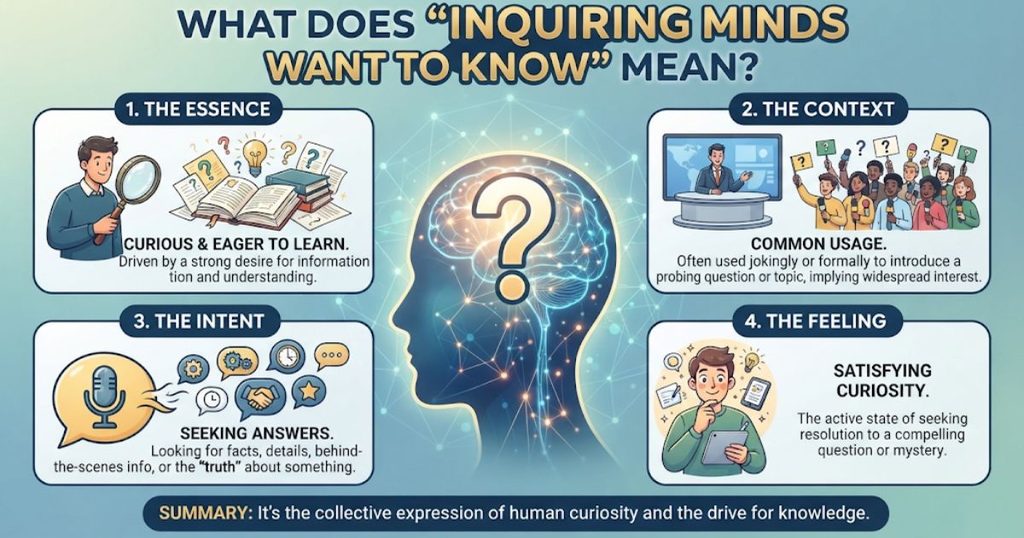
The expression Inquiring minds want to know means that curious people want information about something that is unknown, interesting, surprising, or previously undisclosed.
Cambridge Dictionary lists the expression as an idiom used when someone wants another person to provide information that was previously secret or unknown.
In simple English, it can mean:
• Curious people want answers.
• People are interested in finding out more.
• We would like to know what happened.
• Tell us the details.
• People are wondering about the situation.
The phrase does not necessarily refer to a large group of people. It can be used humorously by one person who wants information.
For example:
“Everyone noticed your new profile picture. Inquiring minds want to know, what happened?”
Here, the speaker is playfully asking for an explanation.
The expression can also be completely sincere:
“Readers have questions about the new policy. Inquiring minds want to know how it will affect them.”
The surrounding context determines whether the phrase sounds serious, playful, sarcastic, or teasing.
Contextual Examples
Literal Breakdown and Parts of Speech
The grammar becomes easier when each word is examined separately.
| Word | Function | Meaning |
| Inquiring | Adjective | Curious or seeking information |
| Minds | Plural noun | People considered as thinking individuals |
| Want | Plural verb | Desire or wish |
| To | Infinitive marker | Connects want with the verb know |
| Know | Base verb | Have information or understanding |
The subject is minds, which is plural. Therefore, the correct verb is want, not “wants.”
The phrase can be understood literally as saying that curious people desire information.
Cambridge defines “inquiring” as wanting to learn new things or wanting to know something.
Casual Conversation Example
Imagine your friend suddenly deletes an old Instagram post.
You might say:
“You deleted that post? Inquiring minds want to know why.”
The wording creates a playful sense of curiosity. It does not necessarily mean you are demanding private information.
Another example could be:
“You have been smiling at your phone all day. Inquiring minds want to know.”
That version is intentionally teasing and may suggest that the speaker suspects something interesting is happening.
Headline Use Example
The phrase can work as a headline hook when a writer wants to create curiosity.
Inquiring Minds Want to Know: What Changed at the Local Stadium?
The first part attracts attention, while the second part tells readers exactly what information they are about to receive.
A colon is useful when the phrase introduces a specific question or topic.
Playful Tagline Example
The phrase works particularly well in humorous taglines.
Inquiring minds want to know: Who ate the last slice of cake?
This does not sound like a serious investigation. It makes an ordinary question feel dramatic and entertaining.
That playful quality is one reason the expression works well in social posts, blogs, captions, entertainment writing, and casual conversations.
Formal Report Rephrased
Although the expression is understandable, it may sound too conversational for a formal report.
Original:
“Inquiring minds want to know how the funds were allocated.”
Formal alternative:
“Stakeholders requested information about how the funds were allocated.”
Another option is:
“Participants requested further clarification regarding the allocation of funds.”
The second versions communicate the same basic idea with a more neutral professional tone.
Common Mistakes
Subject Verb Agreement Errors
One of the most common grammar mistakes is writing:
“Inquiring minds wants to know.”
That is incorrect because minds is plural.
The correct version is:
“Inquiring minds want to know.”
If the subject becomes singular, the verb changes:
“An inquiring mind wants to know.”
This simple distinction is important whenever you use the expression in formal or edited writing.
Misplacing Modifiers
Modifiers should be placed close to the words they describe.
Awkward:
“Inquiring minds want quickly to know the answer.”
Clearer:
“Inquiring minds quickly want to know the answer.”
Even better in many situations:
“Curious readers quickly want to know the answer.”
Clear word placement makes the sentence easier to understand.
Confusing Tense Shifts
The standard phrase uses the present tense:
“Inquiring minds want to know.”
If you are discussing something that happened in the past, you can change the verb naturally:
“Inquiring minds wanted to know what had happened.”
The important point is consistency. Do not switch between present and past tense without a reason.
Using Fragmented Headlines Carelessly
Headlines often use shortened language, but unclear wording can confuse readers.
Weak:
“Inquiring Minds Want to Know: New Policy”
This creates curiosity but does not tell readers what they will learn.
Stronger:
“Inquiring Minds Want to Know: How the New Policy Will Affect Students”
The second version gives readers a clear subject.
Mistake 5: Overusing the Phrase
Repeating the same expression too often can make your writing feel forced.
Instead, vary your wording with alternatives such as:
• Curious readers want answers.
• People are wondering what happened.
• Readers are asking for more information.
• Everyone wants to know the details.
• The question remains unanswered.
Use the phrase when it adds personality rather than inserting it simply for repetition.
American vs British English Differences
Usage Across Varieties
The phrase is understandable in both American and British English. One noticeable difference concerns the spelling of inquiring.
American English commonly uses inquiring, while British English also uses enquiring. Cambridge specifically lists “enquiring” as the UK variant of “inquiring.” (Cambridge Dictionary)
This means you may encounter:
“Inquiring minds want to know.”
and:
“Enquiring minds want to know.”
Both forms communicate the same basic idea.
Tone and Publication Style
The expression tends to sound informal, conversational, or playful.
It can appear in:
• Blogs
• Magazine headlines
• Social media
• Entertainment writing
• Advertisements
• Casual conversation
A formal academic paper would usually benefit from more precise wording.
Punctuation and Quotation
When the expression introduces a specific question, a colon can make the structure clear.
For example:
Inquiring Minds Want to Know: Why Did the Project Change?
If you use the phrase as a standalone sentence, a period is usually enough:
Inquiring minds want to know.
A question mark is generally unnecessary because the phrase itself is a statement about curiosity, although a following direct question can take a question mark.
Cultural Connotation
The expression can suggest genuine curiosity, but it can also carry a teasing or slightly gossip oriented tone.
For example:
“Inquiring minds want to know what happened.”
could be friendly curiosity.
However:
“Inquiring minds want to know all the details of their breakup.”
may sound more intrusive.
The phrase itself is not automatically nosy. Context determines the impression.
Idiomatic Expressions
Phrase as Set Expression
Inquiring minds want to know functions as a familiar set expression. Its meaning is broader than the literal combination of individual words.
It often signals that someone wants information while adding personality to the question.
Instead of simply saying:
“I want to know.”
the phrase makes the request sound more playful:
“Inquiring minds want to know.”
Synonyms and Near Idioms
Several expressions can communicate similar ideas.
| Expression | Tone | Typical meaning |
| Inquiring minds want to know | Playful | Curious people want information |
| Tell me more | Casual | Give additional information |
| I am curious | Neutral | I want to understand |
| We would like to know | Formal | Request for information |
| People are wondering | Neutral | Others are curious |
| We are dying to know | Very casual | Strong curiosity |
| What happened? | Direct | Straightforward question |
The best choice depends on your audience and purpose.
Playful Variants
The expression can be adapted without losing its recognizable character.
For example:
Inquiring minds want to know, and apparently the group chat agrees.
Another variation:
Inquiring minds want to know who finished the cookies.
These versions are particularly natural for humorous posts and captions.
Appropriate Register
Register means the level of formality used in communication.
This phrase is generally best for informal and semi formal situations. It works particularly well when you want curiosity to sound engaging rather than purely factual.
For official documents, a neutral alternative is usually clearer.
Why Inquiring Minds Want to Know Still Works Online?
The phrase has survived because curiosity remains a powerful communication tool.
Social media users often want captions that create an immediate reason to keep reading. A phrase that suggests an unanswered question naturally creates that feeling.
For example:
Inquiring minds want to know: Who started this trend?
The phrase does not answer the question. Instead, it invites attention toward the answer.
This makes it useful for:
• Instagram captions
• TikTok descriptions
• Facebook posts
• Blog headlines
• YouTube titles
• Meme captions
• Entertainment content
The expression can also be shortened in casual writing, but the full phrase is recognizable enough to stand on its own.
The Phrase in Social Media and Pop Culture
The expression became widely recognizable through media and advertising. Historical references connect it with the National Enquirer, which popularized the wording as a promotional slogan. Sources discussing the phrase commonly trace its rise to the publication’s advertising language, with the spelling “Enquiring” appearing in the original form.
Over time, the expression moved beyond its original promotional setting.
It became a familiar phrase used in:
• Television
• Movies
• Magazines
• Comedy
• Online discussions
• Memes
• Everyday speech
Its meaning also became broader. People could use it without referring to the publication or its original advertising context.
Today, someone can write “Inquiring minds want to know” simply to add humor to an ordinary question.
When the Phrase Sounds Sarcastic
Tone is one of the most interesting parts of this expression.
Consider:
“You bought another pair of sneakers? Inquiring minds want to know.”
The speaker may genuinely want to know, but the sentence could also gently tease the person.
Another example:
“You finished the entire cake by yourself? Inquiring minds want to know.”
The phrase adds dramatic humor to a simple question.
Sarcasm is not built into the expression. Instead, sarcasm comes from the situation, voice, surrounding words, and relationship between speakers.
Online, emojis can make the intended tone easier to recognize, but the phrase can still work without them.
Practical Tips
Use the expression when you want curiosity to sound engaging, playful, or slightly dramatic.
Keep these guidelines in mind:
• Use want, because minds is plural.
• Use wants only when the subject is singular.
• Keep the phrase close to the information being requested.
• Add a specific question when clarity matters.
• Use a colon when the phrase introduces a headline topic.
• Avoid repeating the expression throughout the same paragraph.
• Consider your audience before using it professionally.
• Replace it with neutral wording when the subject is sensitive.
• Remember that curiosity should not become an excuse to invade someone’s privacy.
A useful editing test is simple: read the sentence without the phrase. If the sentence becomes clearer and more professional, consider replacing it.
Revision Examples
Revision 1: Fixing Agreement
Incorrect:
“Inquiring minds wants to know the result.”
Correct:
“Inquiring minds want to know the result.”
The correction works because the plural noun “minds” requires the plural verb “want.”
Revision 2: Clarifying Tone
Original:
“Inquiring minds want to know all the gossip.”
Neutral revision:
“Readers are interested in learning more about the situation.”
The revised version removes the playful gossip implication.
Revision 3: Headline Tightening
Weak:
“Inquiring Minds Want to Know: New Update”
Improved:
“Inquiring Minds Want to Know: What the New Update Changes”
The improved headline gives the reader a clear reason to continue.
Revision 4: Rephrase for Formal Report
Original:
“Inquiring minds want to know how the budget was spent.”
Formal:
“Stakeholders requested detailed information about budget expenditure.”
This version is more suitable for professional documentation.
How to Use the Phrase in Modern Content?
Content creators can use the phrase as a curiosity hook, but the question that follows should provide genuine value.
For example:
Inquiring minds want to know: What does this new update actually change?
The headline creates curiosity, while the article should answer the question directly.
Avoid using the phrase merely as clickbait. If a headline promises an answer, the content should actually provide it.
This is especially important for websites that depend on search traffic. Clear, useful content gives readers a reason to stay instead of simply creating curiosity and failing to satisfy it.
Frequently Asked Questions
What does inquiring minds want to know mean?
It means that curious people want information or answers about something that is unknown, interesting, or previously undisclosed.
Is inquiring minds want to know grammatically correct?
Yes. “Minds” is plural, so “want” is the correct verb. “An inquiring mind wants to know” is correct for a singular subject.
Is the phrase formal or informal?
It is generally informal or conversational and often has a playful, teasing, or humorous tone.
What is another way to say inquiring minds want to know?
You can say “People are curious,” “Readers want answers,” “We would like to know,” or “People are wondering.”
Is enquiring minds want to know also correct?
Yes. “Enquiring” is a British English variant of “inquiring,” according to Cambridge Dictionary.
Can I use the phrase on social media?
Yes. It works particularly well in captions, comments, headlines, memes, and posts where you want to express curiosity.
Where did inquiring minds want to know come from?
The expression became widely popular through National Enquirer advertising and later developed into a broader cultural and conversational expression.
Conclusion
The phrase Inquiring minds want to know is a familiar way to express curiosity, interest, or a playful desire for answers. 🧠It can sound serious, funny, teasing, or slightly sarcastic depending on the context. ✨Its grammar is simple because “minds” is plural, so the correct verb is “want.”
The expression works naturally in conversations, social media, headlines, entertainment content, and other informal settings.For formal reports, academic writing, or sensitive topics, a more direct and neutral alternative may communicate your meaning better.Used thoughtfully, the phrase adds personality without making the sentence complicated. 💡