
Gerund examples make English grammar easier when you know one simple idea: a gerund is an English verb form ending in ing that works as a noun.
You can see gerunds in everyday sentences such as “Reading helps me relax” or “She enjoys cooking.” Understanding this form can improve writing, speaking, captions, school assignments, and everyday communication.
📖 This guide explains how gerunds work, where they appear, and how to recognize them quickly. You will also learn common rules, useful sentence patterns, gerund phrases, gerund versus infinitive, common mistakes, and practical examples that make this grammar topic easier to remember.
What Is a Gerund in English Grammar?
A gerund is the ing form of a verb used as a noun. The word still comes from an action verb, but its job in the sentence is different.
For example, in “Swimming is relaxing,” swimming comes from the verb swim, but it names an activity and functions as the subject of the sentence.
A Gerund Is a Verb That Acts Like a Noun
A gerund keeps some features of a verb while performing a noun’s role. It can also take an object.
In “I enjoy reading books,” reading is the gerund and books is its object. This is why simply seeing an ing ending is not enough to identify a gerund.
Simple Gerund Examples for Beginners
Here are easy sentences showing how gerunds can work in different positions:
• Reading improves vocabulary.
• Swimming is good exercise.
• I enjoy listening to music.
• She loves painting.
• They avoid wasting time.
• Cooking can be relaxing.
• He finished doing his homework.
• We talked about traveling.
• Learning English takes practice.
• My favorite hobby is drawing.
The key is to ask what job the ing word performs. If it acts as a noun, it is a gerund.
Why Do English Learners Often Confuse Gerunds?
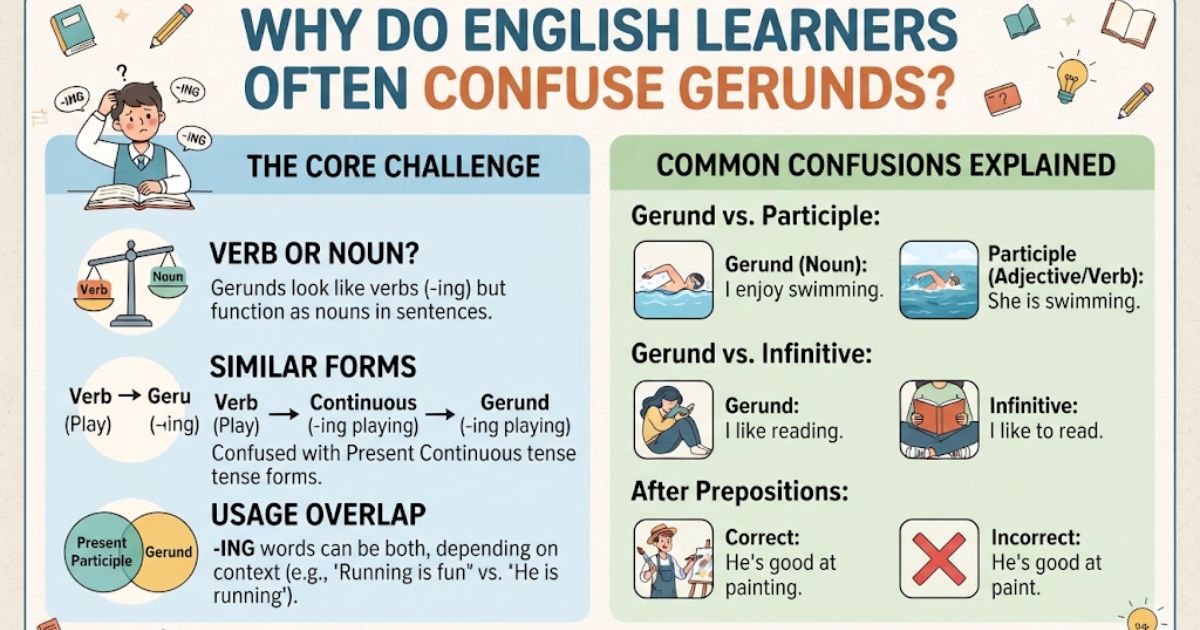
The ing form appears in several grammar structures, so learners sometimes assume every ing word is a gerund. The surrounding sentence gives the answer.
Gerund vs Present Participle Confusion
A present participle usually helps form a verb tense or works as an adjective. In “She is reading,” reading is part of the verb phrase. In “Reading is useful,” reading functions as a noun.
Gerund vs Verb Confusion
A gerund comes from a verb but does not act as the main verb by itself. In “Running is fun,” running is the subject. The main verb is is.
50 Gerund Examples in English Sentences
These examples show gerunds in common grammatical roles:
Gerunds as Subjects
• Walking every morning improves my mood.
• Writing takes patience.
• Studying regularly helps students learn.
• Dancing makes her happy.
• Traveling teaches valuable lessons.
Gerunds as Objects
• I enjoy reading.
• She dislikes waiting.
• We finished cleaning.
• He practices speaking English.
• They considered moving.
Gerunds After Prepositions
• She is interested in learning Spanish.
• He left without saying goodbye.
• We talked about visiting London.
• They succeeded by working together.
• I am tired of explaining the same thing.
More examples include:
• I love gardening.
• She keeps smiling.
• He suggested taking a break.
• We avoided arguing.
• They admitted making a mistake.
• I miss talking to my friends.
• She recommended watching the film.
• He postponed meeting the client.
• We discussed changing the plan.
• She enjoys helping others.
What Are Gerund Phrases?
A gerund phrase contains a gerund plus words that complete or describe it.
For example, “Reading books before bed helps me sleep” contains the gerund phrase “reading books before bed.” The whole phrase acts as the subject.
A gerund phrase can include an object, adverb, or other modifiers. Identifying the complete phrase helps you understand the sentence rather than focusing on one word alone.
Which Verbs Are Followed by Gerunds?
Some verbs are commonly followed by gerunds instead of infinitives. Common examples include enjoy, avoid, finish, consider, suggest, recommend, keep, practice, admit, deny, mind, and postpone.
Examples:
• She enjoys learning new words.
• He avoided answering the question.
• We finished preparing dinner.
• They considered buying a new laptop.
• She suggested taking notes.
Learning these patterns is useful because choosing the wrong form can make a sentence sound unnatural or grammatically incorrect.
Gerund vs Infinitive: What Is the Difference?
A gerund uses the ing form, while an infinitive usually uses to plus the base verb.
| Structure | Example |
| Gerund | I enjoy reading. |
| Infinitive | I want to read. |
| Gerund after preposition | She is good at writing. |
| Infinitive after certain verbs | He decided to leave. |
Some verbs can take either form with little change in meaning, while others change meaning depending on the structure. The safest approach is to learn common verb patterns instead of assuming every verb follows the same rule.
Important Gerund Rules in English Grammar
Keep these rules in mind:
• Use a gerund as a noun: “Swimming is enjoyable.”
• Use a gerund after many prepositions: “She is good at drawing.”
• Use gerunds after common verbs such as enjoy and avoid.
• A gerund can take an object: “I enjoy reading novels.”
• Do not treat every ing word as a gerund. Check its function in the sentence.
How to Identify a Gerund in Seconds
Use a quick three step check:
• Find the ing word.
• Ask whether it names an activity or action.
• Check whether it performs a noun role.
If the answer is yes, you probably have a gerund.
For example, “Running keeps me healthy.” Running names an activity and acts as the subject, so it is a gerund.
Gerund vs Infinitive: Quick Comparison Chart
| Feature | Gerund | Infinitive |
| Form | verb + ing | to + base verb |
| Example | She enjoys singing. | She wants to sing. |
| Common use | After some verbs and prepositions | After some verbs and adjectives |
| Function | Can act as a noun | Can act as a noun or express purpose |
Knowing the pattern of the verb before the blank is often the fastest way to choose the correct form.
Quick Gerund Quiz: Test Your Grammar Skills
Try these before checking the answers:
• I enjoy: books.
• She avoided: late.
• Every day builds confidence.
• He is interested in photography.
Answers:
• reading
• arriving
• Practicing
• learning
These questions help you notice the relationship between the gerund and the words around it.
What Is the Difference Between a Gerund and a Participle?
Both gerunds and present participles use the ing form, but their functions differ.
A gerund acts as a noun: “Swimming is fun.”
A present participle can form part of a verb phrase: “They are swimming.” It can also describe a noun, as in “the swimming child.”
The spelling is similar, but the grammatical role is what matters.
Advanced Gerund Forms That Appear in English Grammar
More advanced structures become useful when you write formal or detailed English.
Passive Gerunds
A passive gerund uses being plus a past participle.
Example: “He dislikes being ignored.”
Here, being ignored describes an action received by the subject rather than performed by the subject.
Perfect Gerunds
A perfect gerund uses having plus a past participle.
Example: “She apologized for having forgotten the appointment.”
This form emphasizes that one action happened before another.
Common Mistakes Students Make With Gerunds
A frequent mistake is assuming every verb can be followed by a gerund. English verb patterns are not completely interchangeable.
Another mistake is calling every ing word a gerund. Always examine the function.
Incorrect: “I enjoy to read.”
Better: “I enjoy reading.”
Incorrect: “She is good in drawing.”
Better: “She is good at drawing.”
Correct patterns become easier when you learn them through repeated examples instead of memorizing isolated definitions.
Real Life Use of Gerunds
Gerunds appear constantly in everyday English, including conversations, messages, school writing, and social media captions.
You might write:
• “Learning something new every day.”
• “Working on myself.”
• “Enjoying the little moments.”
• “Planning my next adventure.”
• “Reading before bed.”
These short phrases show why gerunds are useful beyond grammar exercises. They help describe activities naturally and can make casual writing sound smooth.
Why Gerunds Are Important in Daily English Communication
Gerunds help speakers and writers describe activities as ideas, subjects, or objects. They make sentences more flexible and allow you to talk about hobbies, habits, experiences, and actions.
For social media users, gerunds also appear naturally in short captions. Phrases such as “Chasing goals” or “Creating memories” are concise because the ing form communicates an ongoing activity without needing a long sentence.
Gerund Examples for Social Media and Modern Writing
For Gen Z writers, gerunds often appear in captions, bios, status updates, and short posts.
Examples include:
• Creating my own path. ✨
• Learning, growing, and improving.
• Chasing better days. 🌱
• Choosing peace today.
• Building something meaningful.
• Enjoying life one moment at a time.
These phrases are grammatically useful because the ing form can describe an activity or idea in a compact way.
A Simple Method to Practice Gerunds
Start with five common verbs such as enjoy, avoid, finish, practice, and consider. Write one sentence with each verb and add an ing form.
Then find gerunds in your everyday reading. Look at messages, captions, articles, and conversations. Ask what grammatical job each ing word performs.
This method builds recognition and usage together, which is more useful than memorizing definitions alone.
More Gerund Examples You Can Use
These gerund examples help with revision and writing. “Listening carefully improves understanding” uses listening as the subject. “I practice writing daily” uses writing as an object. “She left without speaking” places speaking after a preposition.
These gerund examples show usage. Create gerund examples with hobbies, routines, and captions. Comparing gerund examples helps you recognize the pattern. Check the function of the ing word, because this is the main clue.
Quick Summary: Gerunds Made Simple
A gerund is an ing form of a verb that functions as a noun. It can be a subject, object, or part of a phrase.
Remember these points:
• Gerunds end in ing.
• Their function is more important than their spelling.
• They commonly follow prepositions and certain verbs.
• They can appear in formal writing and casual communication.
• A present participle may look identical but has a different grammatical function.
Frequently Asked Questions
What is a gerund with examples?
A gerund is an ing form that acts as a noun. Examples include “Reading is fun” and “I enjoy swimming.”
What are 10 simple gerund examples?
Examples include reading, swimming, cooking, dancing, writing, singing, running, painting, traveling, and learning when they function as nouns.
How do you identify a gerund?
Find the ing form and check whether it performs a noun role, such as being the subject or object of a sentence.
What verbs are followed by gerunds?
Common verbs include enjoy, avoid, finish, consider, suggest, recommend, practice, keep, admit, and postpone.
Can a gerund be the subject of a sentence?
Yes. In “Reading improves vocabulary,” reading is the gerund and functions as the subject.
Can a gerund follow a preposition?
Yes. Gerunds commonly follow prepositions, as in “She is interested in learning.”
Is every ing word a gerund?
No. An ing word can also be a present participle. Its function in the sentence determines which form it is.
Conclusion
Gerunds become much easier once you focus on function instead of spelling. The ing form can act as a noun and appear as a subject, object, or part of a gerund phrase.
Use the rules and sentence patterns in this guide to recognize gerunds more confidently. 📚 With regular practice, you can use them naturally in conversations, school writing, captions, and everyday English.