
You are mid-scroll through your messages and someone drops “ima head out” or “ima be real with you” and suddenly you pause. What exactly does IMA mean? Is it slang? An acronym? Both?
The honest answer is that IMA carries multiple meanings depending entirely on where you see it. In casual texting and social media, it is one of the most common shorthand phrases in modern digital communication. In professional and technical contexts, it becomes a completely different word with entirely different purposes.
This guide explains every version of IMA from its primary slang meaning to its linguistic roots across languages and industries with real examples, comparison tables, and clear usage rules that cover every situation.
IMA Meaning? 🧠
In everyday texting and social media, IMA is a slang contraction of the phrase “I’m going to.” It is a phonetic abbreviation that mirrors how people actually say the phrase in casual spoken English the syllables “I’m gonna” compressed into one fast, natural-sounding word.
IMA is not an acronym where each letter stands for something separate. It is a contraction a shortening of spoken language that found its way into written digital communication through texting, rap lyrics, and social media.
Three common meanings of IMA in text:
“I’m going to” by far the most frequent usage. Used before a verb to announce a future action. Example: “Ima call you later.” “I’m” or “I am” a shorter substitution in certain casual phrases. Example: “Ima tired of this.” “I must admit” a less common usage, typically appearing at the start of a confessional or opinionated statement. Example: “IMA, that was a good movie.”
Simple Example:
You: “You coming to the party?” Friend: “Ima try to make it” Translation: “I’m going to try to make it.”
The meaning is immediate, casual, and requires zero formal grammar to understand.
Where Is IMA Commonly Used? 📱
IMA appears across virtually every platform where informal digital communication happens. Understanding where it appears most frequently helps you read it correctly based on platform context.
Common Places:
Text messages and iMessage: The most direct and personal context. IMA here usually means a genuine intention to do something. Instagram captions and comments: Often used for casual announcement or playful self-expression.
Twitter and X posts: Frequently paired with opinions or reactions. “Ima say what everyone else is thinking.” Snapchat: Used quickly to signal upcoming actions without typing full sentences. TikTok comments and captions:
Can carry a sarcastic or humorous tone depending on the video’s context. WhatsApp group chats: Casual among friends, often followed by a plan or statement. Rap lyrics and music: IMA gained significant cultural visibility through hip-hop, where it sounds natural and rhythmically efficient.
Tone:
IMA always reads as casual, friendly, and informal. It signals that the speaker is comfortable, relaxed, and not trying to impress anyone with their grammar which is precisely why it works so well in text-based friendship and relationship communication.
Examples of IMA in Conversation 💬
Seeing IMA in real exchanges makes the meaning click immediately.
Friend: “Where are you?” You: “Ima be there in ten.” Reading: “I’m going to be there in ten minutes.”
You: “Did you finish the work?” Them: “Ima do it tonight, relax.” Reading: Slightly defensive announcement of a future action.
You: “IMA keep it real I forgot.” Reading: “I must admit, I forgot.” used as a confessional opener.
You: “That new song is fire.” Friend: “Ima listen to it now.” Reading: Immediate future intention.
You: “You coming to the game?” Her: “Ima see, text me.” Reading: Uncommitted agreement with a future qualifier.
Notice the consistent pattern: IMA is almost always followed by a verb, and it always announces something the speaker is about to do, plan, or admit.
When to Use and When NOT to Use IMA 🕓
When to Use IMA:
In casual conversations with friends, family, or close colleagues. On social media posts where a relaxed, informal tone fits the content. In text messages where speed and conversational flow matter more than formality.
When you want to sound natural and connected to modern digital communication culture. In creative writing, rap lyrics, or dialogue that reflects authentic casual speech.
When NOT to Use IMA:
In professional emails, reports, or any formal written communication. In job applications, academic writing, or business correspondence. When communicating with someone unfamiliar with English internet slang.
In serious or emotionally heavy conversations where proper phrasing shows care and effort. On platforms or in contexts where grammar expectations are clearly higher.
Context Comparison Table
| Scenario | Should You Use IMA? | Better Alternative |
| Text to a close friend | Yes, completely fine | N/A |
| Instagram caption | Yes, casual tone works | N/A |
| Work email | No | “I will” or “I’m going to” |
| Job application | No | “I intend to” |
| Dating app opener | Depends on tone | Use if it matches your vibe |
| Academic paper | Never | “I will” or “I plan to” |
| Group chat with friends | Yes | N/A |
| Presentation slide | No | “I will demonstrate” |
IMA vs IMMA vs Gonna 🔄
These three terms are the closest relatives in the informal English slang ecosystem, and people mix them up constantly. Here is the clear breakdown.
IMA and IMMA mean exactly the same thing. The only difference is spelling preference. IMMA feels slightly more expressive and drawn out, while IMA is tighter and faster to type. Both are equally valid in casual use.
IMA vs Gonna: “Gonna” is also a contraction of “going to” but it requires a subject pronoun in front of it you still need to say “I’m gonna” while IMA already includes the “I’m” portion. IMA is therefore slightly more compact.
IMA vs Will: “Will” is formal and grammatically standard. IMA is informal and phonetic. They express the same future intention, but the register is completely different. “I will meet you at six” versus “Ima meet you at six” same meaning, entirely different tone.
| Term | Full Meaning | Formality Level | Example |
| IMA | I’m going to | Very casual | “Ima grab food” |
| IMMA | I’m going to | Very casual | “Imma grab food” |
| Gonna | Going to | Casual | “I’m gonna grab food” |
| Will | Will / intend to | Formal | “I will get food” |
| I’m going to | I am going to | Standard | “I’m going to get food” |
IMA Meaning in Different Contexts 🌍
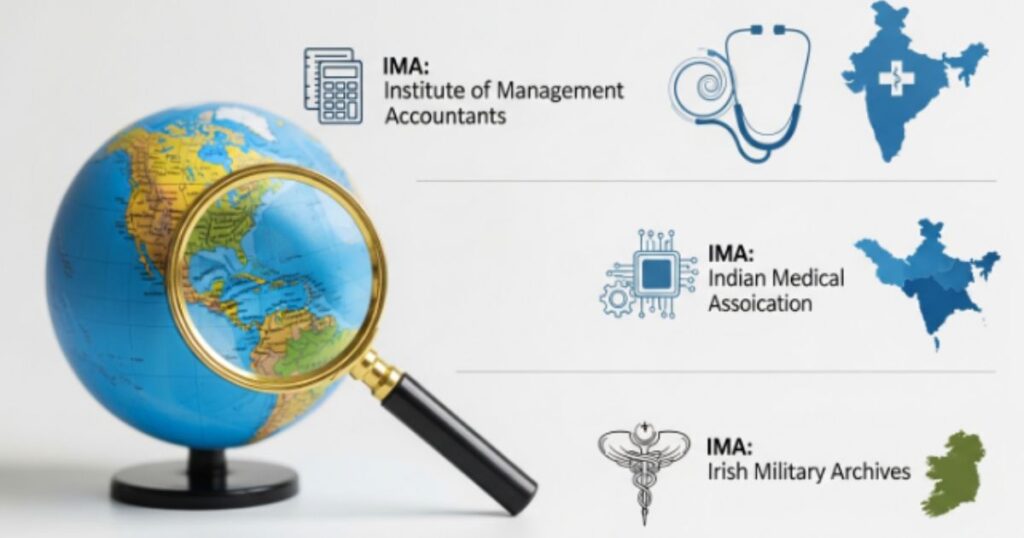
One of the most confusing aspects of IMA is that it means completely different things depending on the language and field you encounter it in. Here is the full cross-context breakdown.
IMA Meaning in English
In English, IMA is casual slang meaning “I’m going to.” It is not a standard dictionary word but is widely understood across all generations who use digital communication regularly.
IMA Meaning in Text or Text Message
In text messages, IMA always signals a future action or a casual admission. It is the most natural way many speakers express intention in informal writing.
IMA Meaning in Japanese
In Japanese, the word “ima” (今) is a standard vocabulary word meaning “now” or “at this moment.” This is not slang it is real, grammatically correct Japanese. Example: “ima doko?” means “where are you right now?” This is completely unrelated to the English texting slang.
IMA Meaning in Hebrew
In Hebrew, “ima” (אמא) means “mother” or “mom.” It is a warm, everyday word for one’s mother. Again, entirely unrelated to the English slang usage. If someone texts you in a Hebrew-language context and says “ima,” they are almost certainly referring to their mother.
IMA Meaning in Urdu and Hindi
In Urdu and Hindi contexts, IMA does not carry a specific native meaning and would typically be interpreted as English slang by bilingual speakers familiar with digital communication culture.
IMA Meaning in Professional and Technical Fields 🧩
Beyond texting slang and language, IMA appears as a formal abbreviation in several specialized fields. These meanings have no connection to casual digital language.
IMA Meaning in Finance or Accounting
IMA stands for Institute of Management Accountants an internationally recognized professional organization dedicated to advancing management accounting and financial management.
According to the Cambridge Business English Dictionary, IMA membership supports financial management skills and offers the Certified Management Accountant designation to qualifying members. This is the formal, professional meaning most likely to appear in business and finance contexts.
IMA Meaning in Engineering or Science
In medical science, IMA refers to Inferior Mesenteric Artery a major blood vessel in the human abdominal region. In chemistry, IMA can refer to Imidazole-4-acetic acid, a neurotransmitter metabolite. These are highly specialized uses found only in academic and clinical contexts.
IMA Meaning in the Car Industry
In the automotive world, IMA stands for Integrated Motor Assist Honda’s proprietary hybrid propulsion system. The Honda IMA system combines a gasoline engine with an electric motor to improve fuel efficiency, recover battery power during braking, and automatically stop and restart the engine at traffic lights. It is one of Honda’s foundational hybrid technologies.
TF IMA Meaning and “Who TF” Usage 😅
“TF IMA” combines TF (the f**k) with IMA to add frustration, disbelief, or dramatic emphasis to an announcement. It does not create a new meaning it simply amplifies the emotion behind the IMA statement.
Example: “TF IMA do now?” translates to “What the hell am I going to do now?” an expression of exasperation rather than a genuine question seeking advice.
This construction is common in reaction posts, meme captions, and social media commentary where emotional exaggeration is part of the communication style.
Why Do People Use IMA Instead of “I’m Going To”?
The reasons are both practical and cultural.
Speed and efficiency: Typing three separate words takes longer than one phonetic contraction. In a fast-paced texting environment, IMA saves time without losing meaning. Natural reflection of speech: IMA mirrors how people actually pronounce “I’m going to” in rapid casual conversation.
It is authentically spoken English written down. Cultural belonging: Using slang signals group membership. People who use IMA identify with informal, modern, digitally native communication culture. Platform character limits:
On platforms like Twitter/X, shorter expressions preserve space for actual content. Tone setting: IMA automatically signals a casual, low-pressure tone that formal phrasing cannot replicate quickly.
The rise of mobile messaging, Gen Z and Millennial communication styles, and hip-hop’s influence on everyday language all contributed to IMA becoming a staple of digital vocabulary.
How IMA Spread Through Pop Culture
IMA did not arrive in text messaging out of nowhere. Its roots trace clearly through African American Vernacular English (AAVE), where “I’m gonna” naturally compresses into “ima” in rapid speech. Hip-hop and rap music carried this pronunciation into mainstream awareness throughout the 1990s and 2000s, where artists used it constantly for its rhythmic efficiency and authentic street-language feel.
As mobile phones and social media platforms became the primary communication tools for younger generations, the spoken word became written word and IMA went from something you said to something you typed. Today it is recognized by Google’s search trends as a growing vocabulary term precisely because language evolves faster than dictionaries can document.
Frequently Asked Questions
What does IMA mean in text messages?
IMA means “I’m going to” in text messages. It is a casual slang contraction used to announce a future action or intention in informal digital conversations.
Is IMA rude?
IMA is not rude it is simply informal. It becomes inappropriate only when used in professional, academic, or formal settings where standard grammar is expected.
Is IMA flirty?
IMA is not inherently flirty, but it can carry a playful or confident tone in the right context. “Ima make you smile today” reads as warm and intentional depending on the conversation.
Can I use IMA at work?
IMA should generally be avoided in professional communication. In formal emails or work documents, “I will” or “I’m going to” is always the safer and more appropriate choice.
Is IMA grammatically correct?
IMA is not standard formal grammar but is completely accepted in casual digital communication. It follows the same informal legitimacy as “gonna,” “wanna,” and “gotta” in everyday spoken and written English.
Conclusion
IMA is one of those small words that carries more weight than its three letters suggest. In texting and social media, it almost always means “I’m going to” a fast, casual, conversational announcement of something the speaker is about to do. In professional and technical contexts, it transforms entirely into formal abbreviations serving finance, medicine, and automotive engineering.
The key is always context. If someone texts you “ima call you back,” they are not referencing the Institute of Management Accountants. If you read IMA in a finance report, they are definitely not about to call you back.
Read the context, match the energy, and you will never misread IMA again.